Horizontal Metal Hammer Crusher for Scrap Cans Recycling
The Horizontal Metal Hammer Crusher is primarily used for the crushing and processing of scrap metal such as aluminium cans, aluminium profiles, aluminium wheel rims, and engine blocks. It breaks the material down into uniform particles through high-speed hammer impact, facilitating subsequent magnetic separation, sorting, and smelting for recycling. Compared to traditional twin-shaft shredders, it is better suited to medium and large-scale metal recycling production lines in terms of output, uniformity of output material, and stability of continuous operation.
Why is the horizontal hammer crusher more suitable for metal recycling lines?
In the scrap metal recycling industry, the efficiency of front-end crushing directly impacts the purity of subsequent sorting and the overall production capacity of the line. The horizontal hammer crusher utilises high-speed rotating hammers to deliver continuous impact to the material. Compared to low-speed shear-type shredding equipment, it offers a faster crushing cycle and produces a more uniform particle size. For lightweight metals such as aluminium cans, thin sheet metal, and aluminium alloy scrap, it effectively reduces entanglement and blockage issues.
Particularly in the processing of aluminium scrap, a uniform output size enhances the efficiency of subsequent eddy current separation and reduces metal loss rates. Some medium to large-scale recycling plants utilise hammer mills as secondary processing equipment, in conjunction with twin-shaft shredders, to improve overall recycling efficiency.
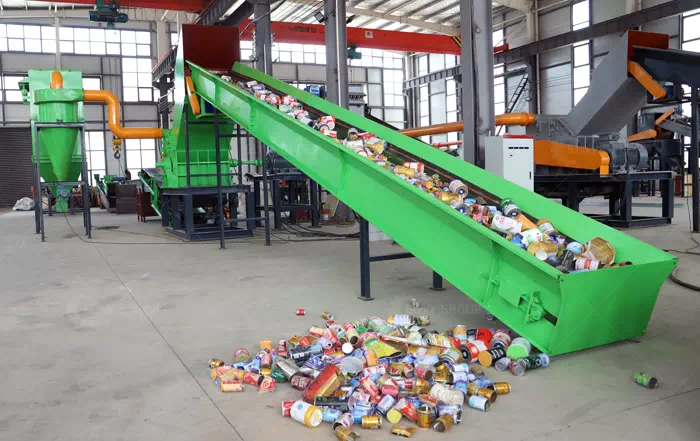
Horizontal Metal Hammer Crusher for Scrap Cans Recycling
Equipment Structure Determines Stability
The core of this type of equipment lies in the rotor structure, hammer material, and power system. Taking the Model 2000 as an example, the total power of the twin motors reaches 264 kW, whilst the main shaft operates at low speed with high torque, balancing both output and stability. The main shaft is made of 40Cr steel and, in conjunction with self-aligning bearings, reduces runout issues during long-term heavy-load operation.
The cutting blades and hammers are typically made from H13 wear-resistant material, which offers more consistent wear resistance than standard alloy steel when processing materials subject to high-frequency impact, such as scrap aluminium and tin cans. The equipment control cabinet is generally equipped with a PLC system and an automatic overload reversal function; should an abnormal metal block enter the system, this automatically protects the main unit, reducing the risk of downtime.
Furthermore, the design of large feed openings represents a significant trend in metal recycling equipment. A feed hopper measuring approximately 3000 × 2000 mm allows for the direct feeding of whole aluminium components or baled material, thereby reducing the need for manual pre-disassembly and improving feeding efficiency.
Trends in Metal Shredding Equipment
Currently, the scrap metal recycling industry demands more from equipment than simply the ability to ‘shred’; greater emphasis is placed on continuous operation, maintenance costs and compatibility with downstream sorting processes. Due to their consistent output, horizontal hammer mills are more easily integrated with magnetic separators, air separation systems, and eddy current separators to form automated recycling lines.
For recycling enterprises processing aluminium cans, scrap aluminium and light, thin iron materials, equipment selection should not be based solely on power output; greater attention should be paid to rotor structure, bearing stability, hammer life, and the ability to integrate with the entire production line. What truly impacts long-term profitability is often the energy consumption and maintenance efficiency during continuous operation, rather than individual parameters.
Recommend products
CONTACT US:
If you have any requirement or suggestion, please fill in the form and send to us, thanks!E-mail:[email protected] | Whatsapp:+8613674945231