Lithium Battery Recycling Machine Price
Price variations in lithium battery recycling equipment stem from differences in pyrolysis processes, crushing and sorting precision, black powder purity, and the level of automation across the entire production line. Depending on the configuration, the cost of a lithium battery recycling production line can range from several hundred thousand to several million yuan; however, the factors that truly determine the return on investment are metal recovery rates, operational stability, and the value of the end-product materials.
Pyrolysis and Crushing Processes Determine Equipment Cost Levels
Current mainstream lithium battery recycling processes generally include discharge, pyrolysis, crushing, air classification, screening, and magnetic separation. Among these, the pyrolysis system is a key factor influencing the price of the entire line.
For waste lithium batteries containing a high proportion of electrolyte, without pyrolysis pre-treatment, subsequent crushing processes are prone to issues such as dust agglomeration, separator entanglement, and reduced black powder purity. Consequently, mid-to-high-end lithium-ion battery recycling lines are typically equipped with continuous pyrolysis furnaces. These utilise low-temperature pyrolysis at 300°C–500°C to remove electrolyte and binders, thereby enhancing downstream sorting efficiency.
Many standard small-scale production lines employ only simple crushing configurations, resulting in lower capital expenditure. However, the resulting black powder contains relatively high levels of copper and aluminium impurities, typically achieving a purity of only 80%–90%. In contrast, production lines equipped with precision air classification and multi-stage screening systems can achieve black powder purity of over 95%, which directly impacts the value of subsequent hydrometallurgical processing.
In terms of equipment configuration:
Semi-automatic lithium battery recycling lines: Lower in price, suitable for small-scale processing;
Continuous automated production lines: Equipped with PLC control, negative pressure dust extraction, and automatic conveying systems, with a significantly higher overall cost;
Complete lines with pyrolysis systems typically incur cost increases of over 30% compared to standard crushing lines.
Higher throughput does not necessarily mean lower cost per tonne.
Many clients tend to overlook one key point: lithium battery recycling equipment is not necessarily more cost-effective simply because it has a higher throughput.
For example:
Small-scale 500 kg/h production lines are suitable for processing electrode sheet material and cell scrap.
Production lines with a capacity of 1,000 kg/h or more are primarily used for the dismantling and recycling of power batteries.
Some large-scale projects even achieve continuous operation at 2–5 tonnes per hour.
However, as throughput increases, the demands on equipment stability rise significantly, including:
The wear resistance of the shredder.
The stability of the air classification system.
Dust extraction and explosion-proof design;
The pyrolysis exhaust gas treatment system.
The continuous operation capability of the conveying system.
Particularly in the recycling of power batteries, due to the complex composition of the materials, unstable equipment structures can easily lead to severe copper and aluminium contamination and high black powder loss rates.
In the industry, mature lithium-ion battery recycling production lines typically achieve copper, aluminium, and black powder recovery rates of over 98%. Whilst low-specification equipment may have a lower purchase price, the costs associated with wear and tear, downtime, and maintenance over the long term are actually higher.
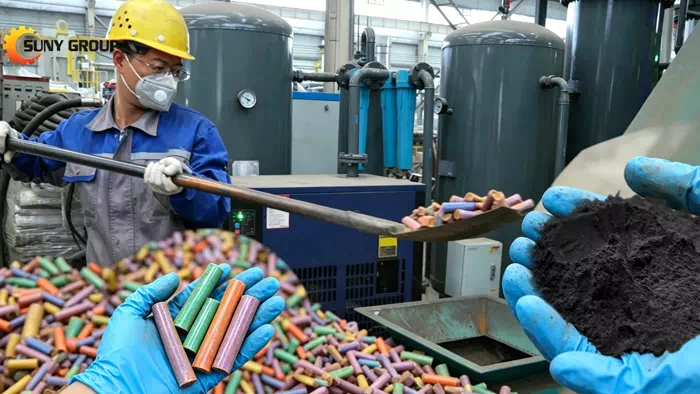
Currently, the key factors influencing the price of lithium-ion battery recycling equipment on the market primarily include:
Whether a pyrolysis system is included;
Processing capacity;
Black powder purity requirements;
Level of automation;
Explosion-proof and environmental protection system ratings;
Raw material type (pouch, cylindrical, prismatic power batteries, etc.).
Therefore, for recycling enterprises committed to long-term operations, equipment stability, recovery rates, and the quality of the end-product material are often more important than simply purchasing at the lowest price. Only a properly configured lithium-ion battery recycling production line can consistently reduce the cost per tonne of processing during subsequent operations and increase overall recycling revenue.
If you are interested in lithium-ion battery recycling or would like to find out more, please feel free to contact us at any time. We will be happy to provide you with detailed information and customised solutions.
Recommend products
CONTACT US:
If you have any requirement or suggestion, please fill in the form and send to us, thanks!E-mail:[email protected] | Whatsapp:+8613674945231