Solar Panel Recycling Technology and Equipment
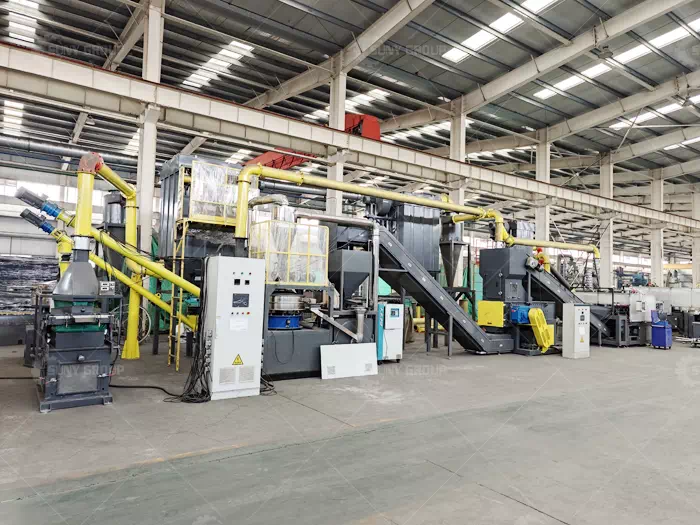
A solar photovoltaic panel recycling production line is an automated system that combines heat treatment, crushing, and multi-stage sorting. It is primarily used to process end-of-life and damaged photovoltaic modules, enabling the separate recovery of materials such as glass, aluminium, copper, silicon powder, and plastic.
Solar Panel Recycling Technology and Equipment
Heat treatment equipment: enabling the delamination of photovoltaic modules
The challenge in recycling photovoltaic panels lies in the tight bond between the glass, solar cells and encapsulation materials. Conventional crystalline silicon modules typically use EVA as the encapsulant. Whilst traditional mechanical crushing can rapidly reduce the size of the material, it tends to cause glass and silicon materials to become intermingled, thereby increasing the difficulty of subsequent sorting.
The combined thermomechanical processing production line first utilises a heat treatment system to soften or decompose encapsulants such as EVA, reducing the bonding strength between the various layers of the module and creating the conditions necessary for the separation of glass and composite materials. The actual operating temperature, processing time, and feed method must be determined based on the module structure and equipment process; separation effectiveness cannot be judged by temperature alone.
Mechanical Crushing and Multi-stage Sorting: Improving Material Recovery Quality
Following thermal treatment, the photovoltaic modules proceed to the subsequent mechanical processing and sorting stages. Depending on the state of the material, the production line can be configured with equipment such as crushers, screens, and air classifiers to progressively separate materials of different particle sizes and physical properties.
Aluminium Recovery: For modules with aluminium frames, a dedicated frame-removal process may be incorporated into the production line configuration to facilitate the separate collection of aluminium.
Glass Recovery: Through layered processing and subsequent mechanical separation, encapsulation materials and other impurities in the glass are reduced.
Copper Recovery: Utilising equipment such as air classification, combined with differences in particle size, density and morphology, improves the separation efficiency of copper-containing components.
Silica Powder and Plastic Recovery: Through downstream screening and fine sorting, fine-particle materials are further processed to reduce the degree of contamination between different components.
It should be noted that the actual recovery purity is closely related to the module type, feed particle size, sorting parameters, and the effectiveness of material pre-treatment. For photovoltaic panels of different ages and structures, material testing should be carried out first before determining the equipment configuration.
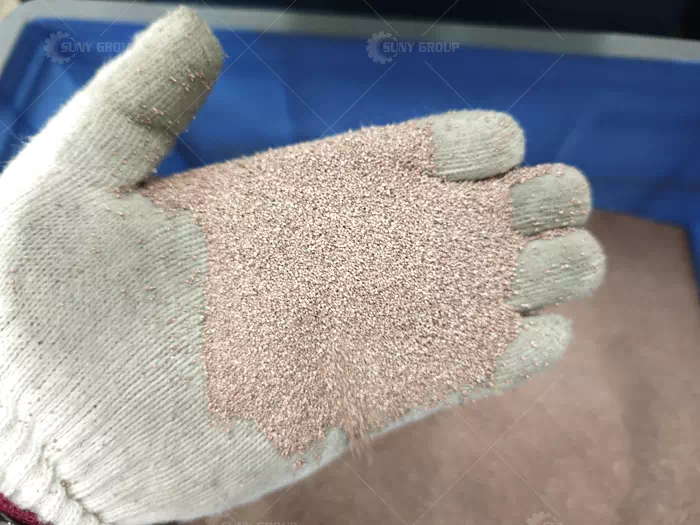
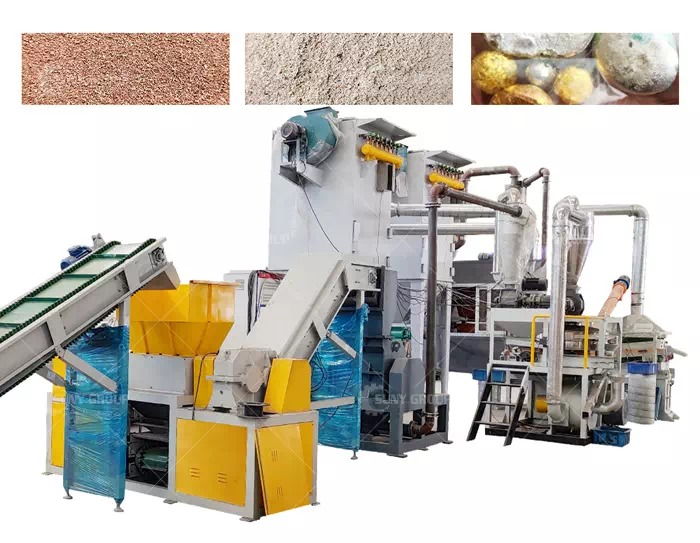
Metal Materials after Solar Panel Recycling
Automated Production Lines: Balancing Processing Capacity and Operational Stability
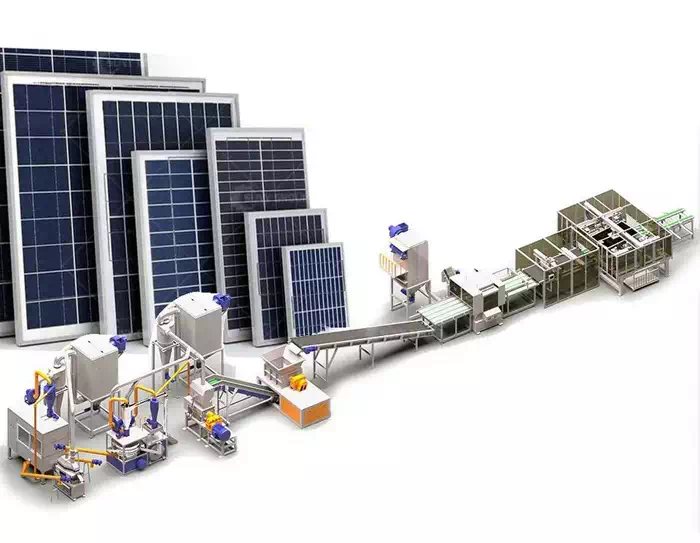
Industrial-scale photovoltaic panel recycling production lines can integrate feeding, heat treatment, mechanical separation, and material collection into a continuous operational process, thereby reducing manual handling and improving the efficiency of equipment coordination. When planning a production line, key factors to evaluate include hourly throughput, energy consumption during heat treatment, equipment operating time, dust collection, and the quality of the finished materials.
Furthermore, photovoltaic modules of different sizes and structures may require distinct feeding and pre-treatment solutions. Appropriate equipment configuration not only enhances the operational stability of the production line but also helps to control energy consumption and subsequent sorting costs.
Therefore, when selecting photovoltaic panel recycling equipment, one should comprehensively consider module type, target production capacity, material recovery requirements, and environmental regulations to ensure that the process configuration is well-suited to the actual raw materials. Should you be interested or require further information, please feel free to contact us at any time to obtain detailed videos and documentation.
Recommend products
CONTACT US:
If you have any requirement or suggestion, please fill in the form and send to us, thanks!E-mail:sunymachine@gmail.com | Whatsapp:+8613674945231