1000kg/h Cable Recycling and Copper Recovery Line
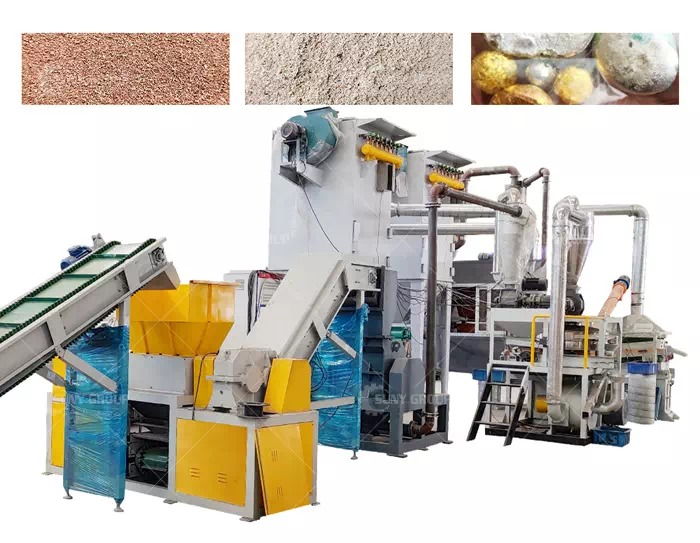
The 1,000 kg/h cable recycling production line utilises equipment such as shredders, crushers, air classification, and electrostatic separation to process waste cables into copper and plastic pellets, enabling the large-scale processing of waste cables, the recovery of copper resources, and the separation of different materials. It is suitable for large-scale cable recycling and processing.
Equipment Configuration of the 1,000 kg/h Cable Recycling Production Line
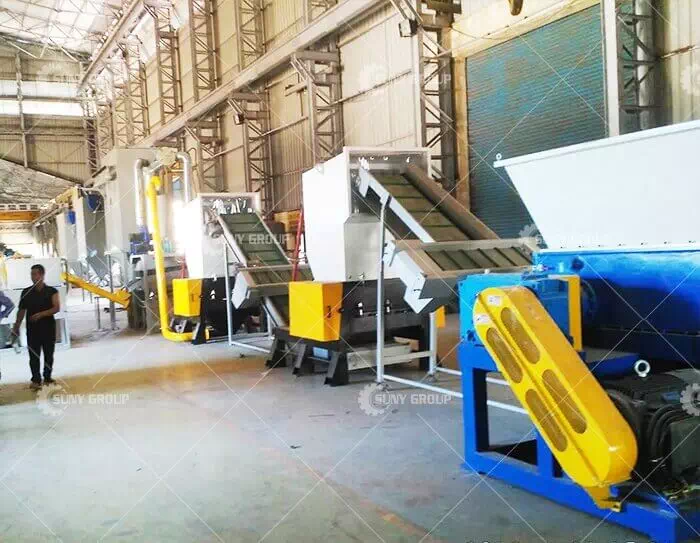
Designed for continuous processing, this production line utilises multi-stage crushing and sorting equipment operating in tandem to handle the dimensions, wire diameters, and mixed metal-plastic structures of waste cables.
At the front end, a shredder performs initial volume reduction on whole cables, cutting longer and thicker cables into material suitable for subsequent processing. The material then enters a crusher, which further separates the copper wires from insulating materials such as PVC and PE, ensuring complete separation of the copper metal from the plastic.
For the processing of large volumes of cables, the feed stability, blade wear resistance, and continuous operation capability of the front-end crushing equipment directly impact the actual output of the entire production line.
Multi-stage sorting equipment achieves separation of copper from plastic.
The shredded mixed material proceeds to the sorting stage. The production line employs a combination of air classification and electrostatic separation to separate copper particles from plastic particles based on their differing physical properties.
Air classification equipment utilises differences in the material’s weight, shape, and aerodynamic properties to perform preliminary sorting of the shredded mixed particles, thereby reducing contamination between copper and plastic.
Subsequent electrostatic separation equipment further exploits the differences in electrical conductivity between copper and non-metallic plastics to enhance the separation of copper particles. For mixtures containing fine copper wires and fine plastic particles, particle size, moisture content, and the uniformity of the material all affect the separation results.
Consequently, in actual production, equipment parameters must be adjusted according to cable type, shredding particle size, and material composition, rather than simply relying on increasing the shredding speed to boost recovery rates.
1,000 kg/h Throughput Capacity and Copper Recovery Efficiency
This production line is designed with a throughput capacity of 1,000 kg/h and is suitable for recycling plants requiring the continuous processing of large volumes of waste cables. The equipment configuration can be adjusted according to cable type, feed size, target copper particle size, and plant conditions.
It should be noted that 1,000 kg/h refers to the production line’s designed throughput capacity and does not imply that 1,000 kg of copper can be recovered per hour. The actual amount of copper recovered depends on the copper content in the raw material, the proportion of insulating material, the operational status of the equipment, and the effectiveness of the sorting process.
When selecting equipment, cable recycling enterprises should focus on three key aspects: the degree of separation between copper and plastic after crushing; the sorting equipment’s capacity to handle fine particles; and the stability of continuous operation across the entire production line. These factors collectively determine the final quality of copper recovered and production efficiency.
Recommend products
CONTACT US:
If you have any requirement or suggestion, please fill in the form and send to us, thanks!E-mail:sunymachine@gmail.com | Whatsapp:+8613674945231