How Do We Sort and Recover Electronic Components from Waste PCBs?
The key to recovering electronic components from end-of-life PCBs lies in utilising step-by-step disassembly, screening, magnetic separation, and intelligent sorting equipment to separate the electronic components from the circuit boards and to recover materials with different physical properties and values.
PCB Recycling and Disassembly
End-of-life PCBs consist of a mixture of electronic components, solder, copper, glass fibre, resin and various other materials. If all materials were to be directly shredded at the outset, electronic components might be damaged or become mixed with fine PCB particles, thereby increasing the difficulty of subsequent separation.
Consequently, the disassembly system serves as the primary processing stage. Through controlled mechanical action, this system loosens and separates electronic components from the PCB surface whilst minimising unnecessary damage to the components. The processed material is then conveyed to the screening stage.
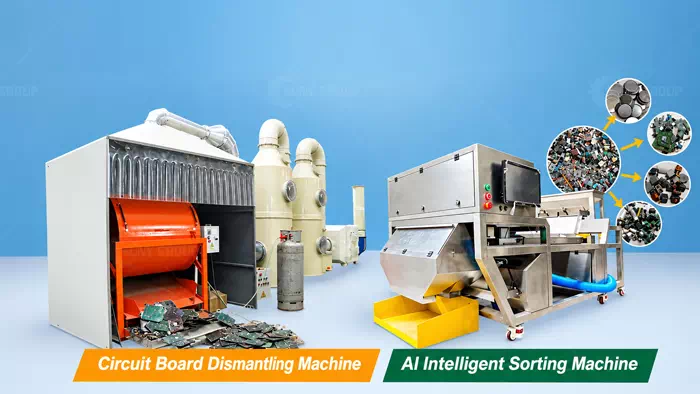
Circuit Board Dismantling & AI Sorting System
Vibrating Screening and Magnetic Separation
Once disassembly is complete, the material enters the vibrating screening system. The vibrating screens separate the material according to particle size, enabling different categories of material to be processed separately.
This step is crucial, as particle size control directly affects separation efficiency. Larger electronic components, PCB fragments, metal particles, and fine particulate fractions often possess vastly different physical properties. Screening transforms the mixed material stream into several more manageable streams, rather than processing it as a single mixture.
Magnetic separation is then employed to remove magnetic metals from the screened material. Ferromagnetic particles are separated under the influence of a magnetic field, isolating them from non-magnetic components and PCB fragments. This not only reduces the metal content entering subsequent sorting stages but also improves the consistency of the remaining material.
The combined ‘dismantling–vibrating screening–magnetic separation’ process is more practical than operating with a single piece of equipment. Each unit performs a specific separation task, and the entire system can be flexibly configured according to the composition of the feed material and the required output quality.
AI Sorting Technology
In the final stage, an AI-powered sorting system is employed to identify and separate target electronic components from the residual material.
Unlike traditional mechanical separation methods, AI sorting technology utilises visual features and pre-set recognition rules to distinguish between different objects on the conveyor belt. The system identifies components based on shape, size, surface appearance, and other detectable features, thereby triggering the sorting mechanism to separate the selected materials.
This system is particularly suitable when the feed contains multiple types of components and efficient separation cannot be achieved based on size or magnetic properties alone.
Consequently, a complete PCB component recycling production line can be configured according to the following process:
Input of waste PCBs → Disassembly system → Vibrating screen → Magnetic separation → AI sorting → Output of clean components
Recovered electronic components in good condition that meet market demand can be reused directly, whilst other material components can be sent to subsequent processes for the recovery of metals or precious metals.
Recommend products
CONTACT US:
If you have any requirement or suggestion, please fill in the form and send to us, thanks!E-mail:[email protected] | Whatsapp:+8613674945231