AI E-Waste Sorting Robot for Electronic Components
AI sorting robots for e-waste recycling use visual recognition and automated picking technology to identify capacitors, chips, connectors, inductors and other electronic components, reducing manual sorting work and improving the consistency of component separation.
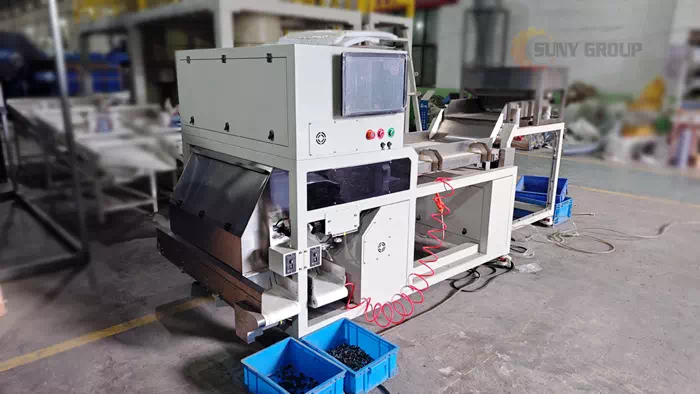
AI E-Waste Sorting Robot for Electronic Components
AI sorting robots used for e-waste recycling utilise visual recognition and automated picking technology to identify capacitors, chips, connectors, inductors, and other electronic components, thereby reducing the need for manual sorting and improving the consistency of component separation.
AI Recognition and Automated Sorting
Once e-waste has been dismantled, it typically results in a large volume of mixed electronic components varying in size, shape, and material. Traditional manual sorting requires a continuous investment in labour, and when handling large volumes of material, efficiency and sorting consistency are easily compromised.
Our AI-powered sorting robot system is primarily designed for the automatic identification of dismantled electronic components. Once the material enters the equipment, the vision system captures features such as the components’ appearance, dimensions, and position; AI algorithms then determine their category, after which a robotic arm performs the gripping and sorting. For different components such as capacitors, inductors, chips, connectors and sockets, the equipment can divert them according to pre-set categories, providing more uniform raw materials for subsequent metal recycling and resource extraction.
Compared to relying solely on manual sorting, the core value of this equipment lies not only in ‘reducing labour’, but also in its ability to identify and sort materials from different batches according to relatively consistent rules.
Processing capacity: 200–300 kg/h
Depending on the equipment configuration, this AI sorting robot has a processing capacity of approximately 200–300 kg/h. Actual output is influenced by factors such as material composition, component size, the number of identification categories, and the robotic arm’s gripping frequency; therefore, when configuring the entire production line, the system must be matched to the actual output of the upstream dismantling equipment.
Currently, this equipment can be used in conjunction with a PCB dismantling machine with a processing capacity of approximately 500 kg/h. The upstream equipment is responsible for breaking down the materials and initially releasing the electronic components, whilst the AI robot carries out further precise identification and sorting; together, they form a continuous ‘dismantling–identification–sorting’ processing workflow.
The key to this configuration lies not in maximising the speed of any single piece of equipment, but in maintaining a reasonable balance of production capacity between the upstream and downstream processes, thereby preventing material build-up at the front end or idle time for the downstream sorting equipment.
Targeting the Recovery of High-Value Electronic Components
In the processing of electronic waste, components such as chips, connectors, capacitors and inductors often possess value for further recovery. Following AI sorting, components of different categories can be collected separately, minimising the impact of material mixing on subsequent processing. This equipment is also better suited to forming a complete production line in conjunction with PCB disassembly, crushing, magnetic separation, eddy current separation and metal recovery equipment, rather than being used as a standalone unit. By combining front-end mechanical processing with back-end intelligent recognition, the recovery efficiency of valuable components from electronic waste can be further enhanced.
Recommend products
CONTACT US:
If you have any requirement or suggestion, please fill in the form and send to us, thanks!E-mail:[email protected] | Whatsapp:+8613674945231