Aluminium Copper Radiator Scrap Recycling Plant
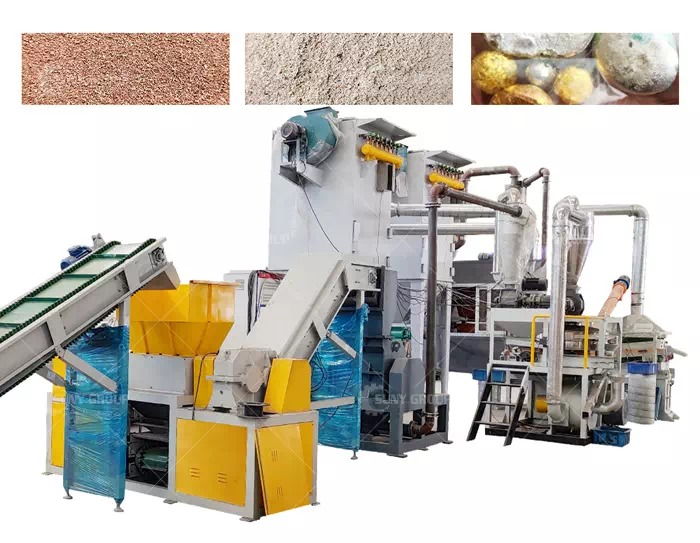
The aluminium copper radiator scrap recycling plant is a system of equipment specifically designed for the efficient crushing and sorting of composite metal materials, such as waste air-conditioning radiators and automotive radiators. Its core function lies in thoroughly separating the tightly bonded copper and aluminium, thereby enabling resource reuse and maximising value, whilst reducing manual dismantling costs and improving processing efficiency and environmental standards.
1. Overall Line Configuration and Core Equipment
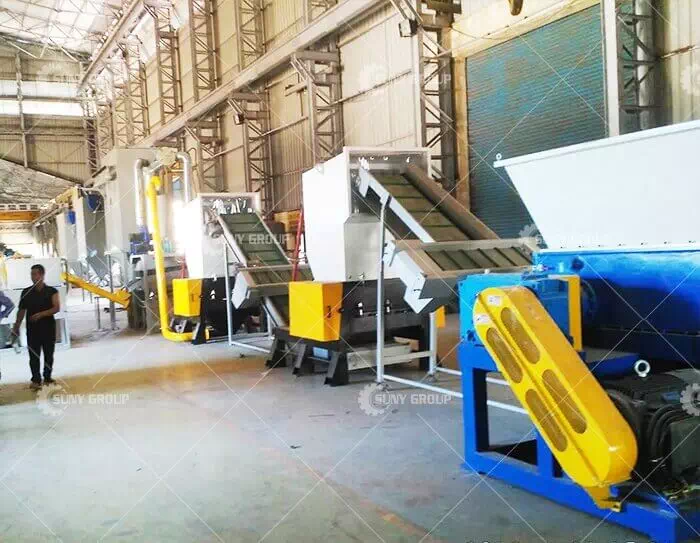
The complete aluminium-copper radiator crushing and sorting line comprises multiple pieces of equipment working in concert to form a continuous, automated workflow. At the front end, a conveyor ensures a steady feed of material, maintaining a consistent operational rhythm throughout the line. Upon entering the core crushing stage, a twin-shaft shredder performs the primary crushing task, coarsely shredding larger radiators to a size suitable for further processing; this step directly determines the efficiency of subsequent separation.
Subsequently, the material enters a hammer mill for secondary fine crushing. High-speed rotating hammers thoroughly break down the copper tubing and aluminium foil structure, ensuring complete separation of the two metals. The crushed mixture then enters the sorting system, where gravity separation equipment utilises density differences to perform preliminary separation, effectively distinguishing the heavier copper from the lighter aluminium.
To further enhance purity, the system is equipped with a colour sorter to perform precise identification and sorting of the mixed metal particles, ensuring that impurities are accurately removed. The entire process is supported by a dust collection system to minimise dust emissions, guaranteeing a stable production environment and compliance with environmental regulations.

2. Process Flow and Sorting Principles
This production line adopts a ‘two-stage crushing + two-stage sorting’ structural design; this is not a simple combination, but rather the result of optimisation tailored to the characteristics of aluminium-copper composite materials. The objective of the first-stage crushing is to reduce particle size, whilst the key to the second-stage crushing is to achieve structural separation; if separation is insufficient, even the most advanced subsequent sorting equipment will be ineffective.
During the sorting stage, gravity separation is first used to achieve a high-yield separation, followed by colour sorting equipment for fine purification. This combination effectively resolves the issue of unstable purity found in traditional sorting methods. Through this multi-tiered screening mechanism, the final separation rate of copper and aluminium can be consistently maintained at 99.9%.
It is important to note that the core variables affecting sorting performance are not the number of machines, but rather the control of particle size and material uniformity. If the particle size of the feed material is inconsistent, sorting efficiency at the downstream stage will decline significantly. Therefore, the focus of the entire line design lies in the coordination between equipment and the control of processing rhythms, rather than simply stacking the performance of individual machines.
3. Advantages and Practical Value of Equipment Application
Compared to manual dismantling or single-unit crushing equipment, the advantages of this type of automated recycling line lie in its stability and large-scale processing capacity. Firstly, it offers strong continuous operation capabilities, making it suitable for the bulk processing of scrap radiators; secondly, it achieves high sorting precision, enabling the direct output of high-purity copper and aluminium granules, which facilitates subsequent sales or reprocessing.
In terms of cost structure, although the initial equipment investment is relatively high, in the long term it can significantly reduce labour costs whilst minimising resource wastage and increasing recycling revenue. For enterprises engaged in scrap metal recycling, resource regeneration or environmental treatment, this type of production line represents more of an ‘industrial solution’ than merely a set of equipment.
Overall, the core value of an aluminium and copper radiators crushing and sorting line lies not in ‘whether it can sort’, but in ‘whether the sorting is stable, efficient and capable of sustainable operation’. For enterprises seeking to enhance recycling efficiency and material value, this represents a practical and profitable technical pathway.
Recommend products
CONTACT US:
If you have any requirement or suggestion, please fill in the form and send to us, thanks!E-mail:sunymachine@gmail.com | Whatsapp:+8613674945231