Enhanced Rubber and PVC Hose Recycling Production Line
Due to the complex structure of hydraulic hoses—which typically consist of a rubber layer and a high-strength steel wire braided layer—improper processing methods not only result in low separation efficiency but also lead to waste of resources and even equipment damage. Therefore, a recycling production line with a clear structure and well-defined roles is key to maximising recycling value.
The core of this hydraulic hose recycling production line, developed by SUNY GROUP, lies in ‘graded shredding + precise separation’. The first stage of the system is the twin-shaft shredder, which serves as the pre-treatment unit. Compared to single-shaft equipment, the twin-shaft design offers distinct advantages when dealing with hydraulic hoses that are highly resilient and prone to tangling, enabling the entire hose to be rapidly shredded into relatively uniform chunks. The objective of this step is not to achieve fine particle size, but rather to create stable feed conditions for subsequent processing, thereby preventing blockages or tangling issues.
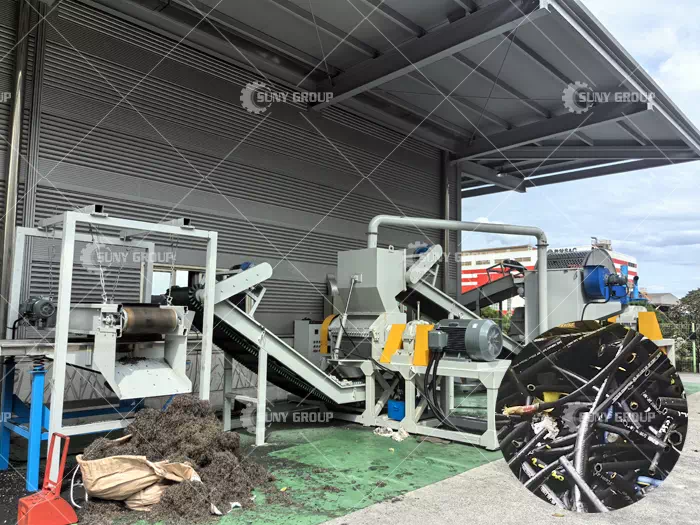
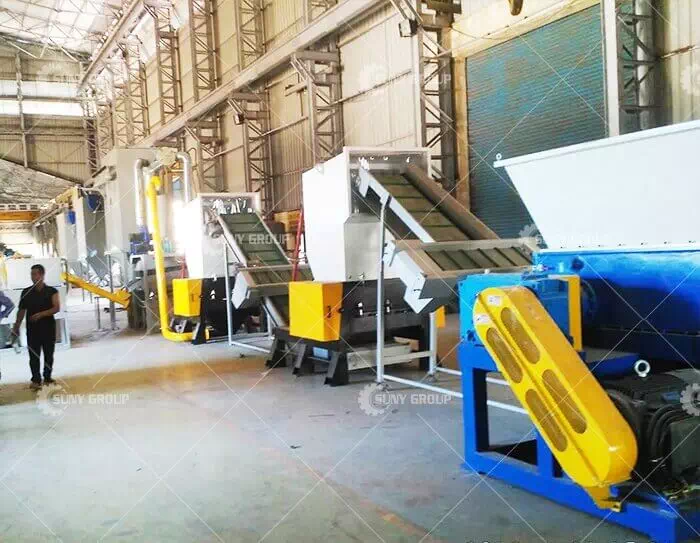
Korean Customer Hydraulic Rubber Hose Wire Separation Equipment Site
Following initial shredding, the material enters the drum screening system. Many tend to overlook this stage, yet it directly impacts the efficiency of the entire production line. Through screening, the drum screen returns oversized material for reprocessing whilst ensuring that the material entering the next stage has a uniform particle size, thereby enhancing the stability of downstream crushing and separation at the source. This ‘screening and recirculation’ design significantly reduces energy consumption and minimises equipment wear.
Next comes the critical stage of the entire production line: the heavy-duty crusher. The objective at this stage is clear: to achieve effective separation of rubber from steel wire. Through high-intensity impact and shearing forces, the heavy-duty crusher further pulverises the pre-treated material whilst breaking down the bond between rubber and metal, allowing the two to gradually separate. This process places extremely high demands on equipment strength and wear resistance; an ill-conceived design can easily lead to accelerated tool wear and reduced processing capacity.
Once crushing is complete, the material enters the magnetic separation system. The magnetic separator utilises differences in magnetic properties to efficiently separate steel wires and metal fittings from the rubber particles. This step directly determines the purity and value of the recovered metal. High-quality magnetic separation equipment not only ensures thorough separation but also minimises rubber carry-over, thereby improving overall resource utilisation.
The strength of the entire production line lies not in the performance of individual units, but in the coordination and compatibility between each stage. From shredding, screening, and crushing to magnetic separation, every step is designed with ‘stable operation’ and ‘efficient separation’ in mind, ensuring the equipment can accommodate hydraulic hoses of varying specifications whilst maintaining consistent output during prolonged operation.
If your primary focus is on the returns from recycling rather than the equipment itself, then this clearly structured and well-organised hydraulic hose recycling solution is the direction in which your investment should be directed.
Recommend products
CONTACT US:
If you have any requirement or suggestion, please fill in the form and send to us, thanks!E-mail:[email protected] | Whatsapp:+8613674945231