Lithium-ion Battery Black Mass Recovery Equipment
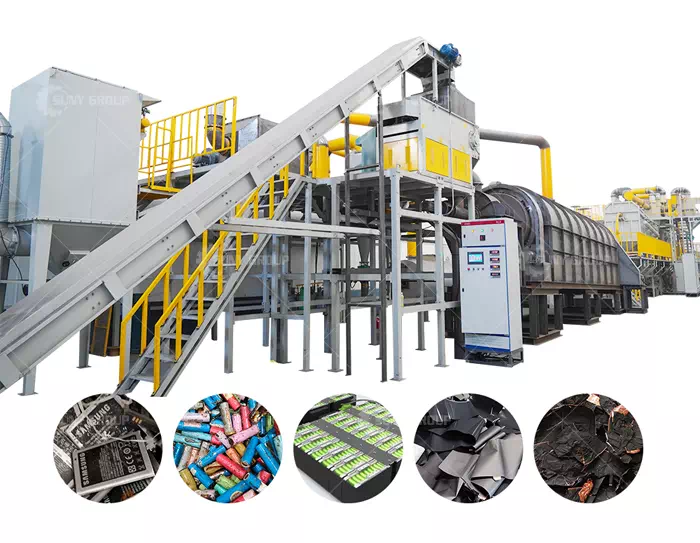
The lithium-ion battery black mass recovery production line developed by SUNY GROUP primarily utilises equipment such as discharge units, crushers, heat treatment units, screening machines, and air classification systems to separate black mass, copper, aluminium, and casing materials from end-of-life lithium-ion batteries, thereby providing raw materials for the subsequent deep recovery of lithium, nickel, cobalt, manganese, and other elements from the black mass.
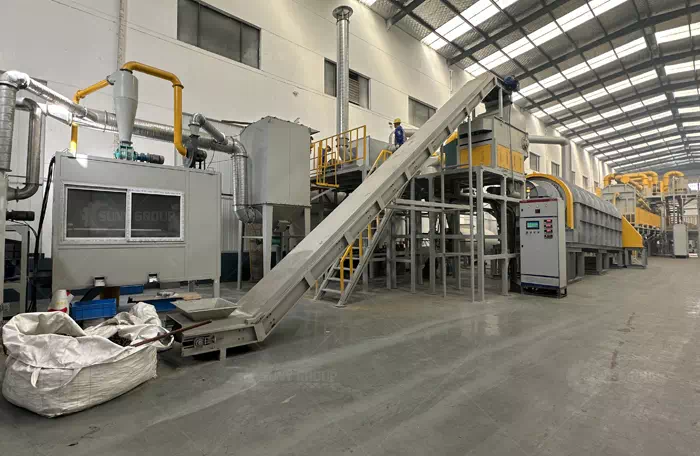
Lithium-ion Battery Black Mass Recovery Equipment
Key Equipment of the Black Mass Recovery Line
A complete Lithium-ion Battery Black Mass Recovery Plant typically consists not of a single piece of equipment, but of multiple functional modules.
Discharging equipment is used to reduce the residual voltage in end-of-life batteries, thereby minimising safety risks such as short circuits and fires during the subsequent crushing process. Depending on the battery type and project requirements, a discharging unit may be employed for pre-treatment.
Shredders and crushers are the core equipment for mechanical processing. Waste cylindrical, pouch, and prismatic batteries, as well as electrode scrap, undergo primary shredding before proceeding to secondary crushing, which gradually separates the active material from the copper and aluminium foils. The equipment is typically fitted with a sealed structure and a nitrogen protection system.
For battery materials containing significant amounts of electrolyte and binder, low-temperature volatilisation or pyrolysis furnaces may be incorporated. Data indicates that thermal treatment schemes can process electrolyte, PVDF binder, and separators at temperatures of approximately 400–650 °C under oxygen-deprived conditions, thereby improving the separation of black powder from metal foil in subsequent stages.
Screening, Sorting and Exhaust Gas Treatment
Materials that have undergone crushing or heat treatment require further processing through multi-stage sorting equipment to enhance product purity.
Circular vibrating screens are primarily responsible for screening fine powders, separating black powder with smaller particle sizes from the mixture; gravity separation equipment utilises differences in material density to remove some iron, stainless steel and other casing materials; whilst air classifiers further separate copper, aluminium and lightweight materials based on particle density, shape and aerodynamic characteristics.
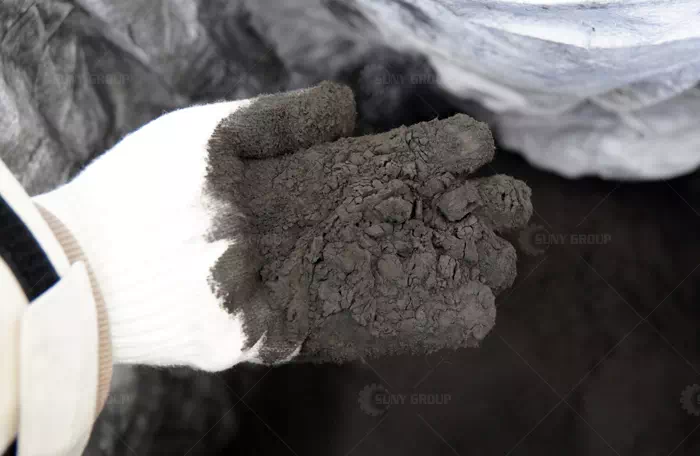
Black Powder from Lithium Battery Recyclin
Some production lines are also equipped with magnetic separation equipment, conveying systems and automatic feeding systems, enabling different materials to be fed continuously into the next process stage. The final products typically include black powder, copper granules, aluminium granules and iron/steel casings. According to equipment documentation, the black powder recovery rate for some configurations can reach over 98 per cent; however, specific results depend on the battery type, feed composition and equipment configuration.
Safety and environmental protection equipment are equally important components of the entire production line. Nitrogen purging systems are used to reduce oxygen concentrations in the crushing area; dust collectors, cooling units, scrubbers and activated carbon adsorption systems are employed to treat dust, VOCs and acidic gases. The actual configuration should be determined based on local emission standards and the properties of the raw materials.
Finally, it should be noted that the black powder recovery rate is not equivalent to the final recovery rate of metals such as lithium, nickel and cobalt. Mechanical processing lines primarily carry out the enrichment and physical separation of black powder; if products such as lithium carbonate, nickel sulphate and cobalt sulphate are to be obtained, subsequent hydrometallurgical processes must be incorporated.
Therefore, when selecting lithium battery black mass recovery equipment, the focus should be on determining the equipment configuration based on the battery chemistry, feed form, processing capacity, target product purity, and local environmental requirements, rather than simply comparing the price or production capacity of individual machines. If you are interested in or require production lines for lithium battery recycling equipment, please feel free to contact us at any time for further videos and quotations.
Recommend products
CONTACT US:
If you have any requirement or suggestion, please fill in the form and send to us, thanks!E-mail:[email protected] | Whatsapp:+8613674945231