Motor Cutting and Copper Extracting Machine
Motor cutting and copper wire extraction machines are primarily used to process various types of end-of-life industrial, domestic appliance, and automotive motors. Through processes such as mechanical cutting, stator separation, and copper wire extraction, they enable the effective sorting and recovery of copper and iron. Compared to manual dismantling, this equipment not only reduces labour intensity but also improves copper recovery efficiency and material purity, making it particularly suitable for large-scale end-of-life motor recycling operations.
Core structure of end-of-life motor recycling equipment
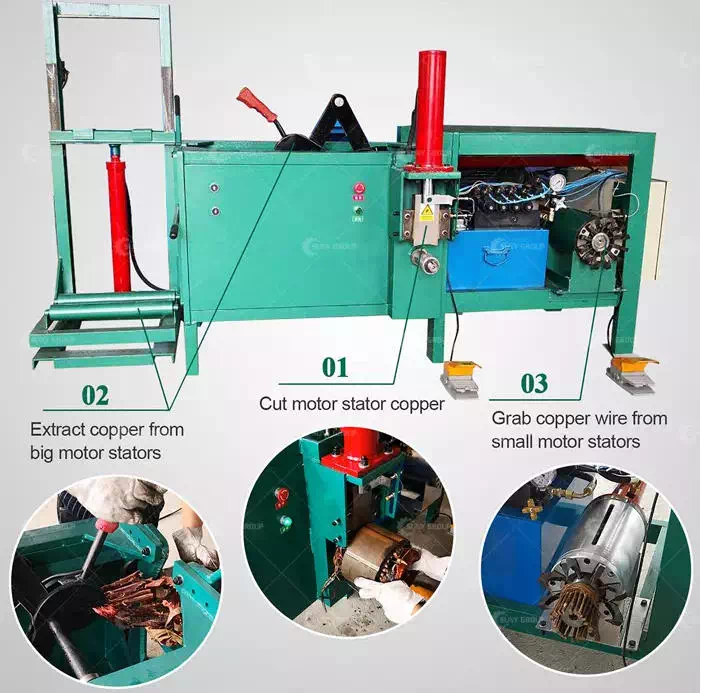
Motor Cutting and Copper Extracting Machine
Such motor recycling equipment typically consists of three components: a motor casing cutter, a stator copper-cutting unit, and a copper wire extraction system. During operation, the cutting mechanism first dismantles the casing of the end-of-life motor, completely separating the stator section. Subsequently, the stator copper-cutting unit performs a ring-cutting process on the windings, creating a separable interface between the copper wires and the silicon steel laminations. Finally, the copper extraction system pulls the copper wires out in one piece.
Compared to traditional manual motor dismantling, the greatest advantage of mechanised processing lies in its consistency. Manual dismantling is not only inefficient but also prone to damaging the copper wires, thereby reducing their subsequent recycling value. Mechanical cutting, however, preserves the integrity of the copper wire structure, minimising material wastage. For small and medium-sized recycling enterprises, this type of equipment is better suited to processing large volumes of motor waste.
In terms of specifications, the ZY-MC500 model developed by SUNY GROUP has a power rating of 4 kW, weighs approximately 480 kg, and has a footprint of around 2.6 × 1 × 1.2 metres, making it a typical small-to-medium-sized motor dismantling machine. Its compact size requires minimal workshop space, making it particularly suitable for small and medium-sized recycling sites or resource recovery enterprises.
Which recycling scenarios are best suited for motor dismantling equipment?
Currently, this type of equipment is primarily suitable for waste electrical and electronic equipment (WEEE) dismantling plants, motor repair businesses, metal recycling centres, and electronic waste processing enterprises. For users with smaller recycling volumes, a single unit can handle basic dismantling; for large-scale recycling projects, it can be integrated with crushing, magnetic separation, and metal sorting systems to form a complete production line.
Furthermore, the dismantling methods for motors of different specifications are not entirely consistent. For example, motors from small household appliances are better suited to rapid cutting, whilst large industrial motors place greater emphasis on the stability of the stator. Therefore, when selecting equipment, one should not focus solely on output capacity, but should also consider the range of motor sizes covered, the wear resistance of the cutting tools, and the long-term maintenance costs.
From the perspective of industry trends, the recycling of waste motors is no longer merely a matter of waste disposal, but is gradually evolving towards the refined utilisation of resources. Those who can achieve copper-iron separation more efficiently and reliably will be better positioned to secure greater economic benefits within the renewable resources sector.
Recommend products
CONTACT US:
If you have any requirement or suggestion, please fill in the form and send to us, thanks!E-mail:[email protected] | Whatsapp:+8613674945231