PCB Depopulation Shredding and Separation Line
The PCB depopulation, shredding, and separation production line is a system of equipment designed for the resource recovery of waste printed circuit boards. It first separates electronic components through thermal depopulation, then utilises multi-stage shredding, screening and physical sorting to recover copper and non-metallic resin powders, thereby minimising the impact of the mixture on subsequent processing.
PCB Thermal Depopulation Machine: Separating Electronic Components First
End-of-life printed circuit boards typically consist of a substrate, solder joints, and various electronic components. If an entire PCB were fed directly into a shredder, the components, copper, and resin would become intermingled, making subsequent sorting more difficult. Therefore, a complete PCB recycling line usually incorporates thermal depopulation as a front-end pre-treatment stage.
A PCB thermal disassembly machine primarily comprises a feeding system, a heating chamber, a component separation mechanism, a discharge system, and a control unit. The equipment utilises natural gas for heating, with the chamber temperature capable of reaching approximately 400°C, causing the zinc-based solder on the circuit boards to melt or soften, allowing the electronic components to be detached from the substrate by mechanical action.
The disassembled material is generally divided into two parts: bare PCB substrates and electronic components. The former proceeds to the subsequent crushing and sorting system, whilst the latter can be collected separately according to material composition, facilitating subsequent metal resource processing. During actual operation, the temperature, heating time, and feed method must be adjusted according to the type of PCB and the characteristics of the solder; a single set of parameters cannot simply be applied across the board.
PCB Substrate Crushing and Physical Sorting Equipment
Following thermal disassembly, the bare PCB substrates enter the crushing and separation stage. The core task of this system is to progressively reduce the particle size of the material, enabling the copper to be thoroughly separated from non-metallic materials such as glass fibre and epoxy resin.
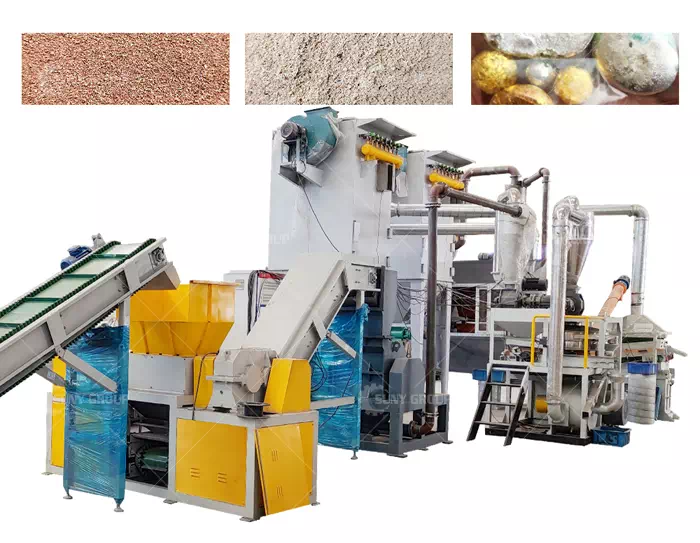
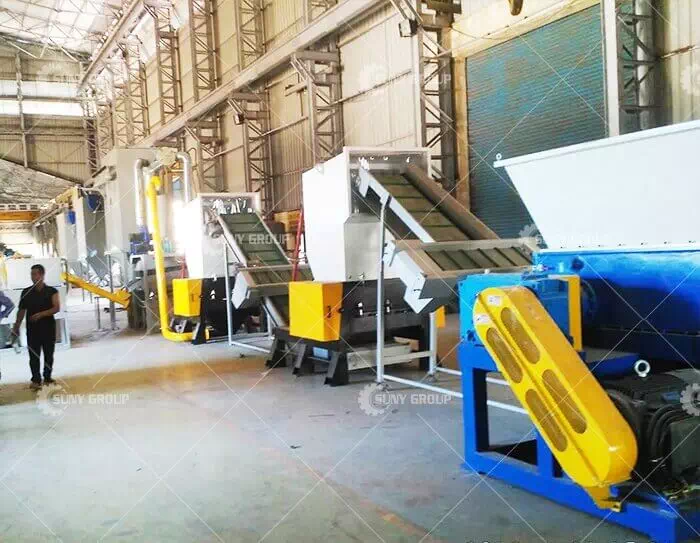
The production line is typically equipped with a shredder or primary crusher, a hammer mill, fine crushing or grinding equipment, a vibrating screen, an air classifier and an electrostatic separator, along with supporting conveyor systems, pulse dust collectors and a PLC control cabinet.
Firstly, the coarse crushing equipment breaks down larger PCB substrates into sizes suitable for subsequent processing, thereby reducing the feed load on the fine crusher. Subsequently, hammer mills and grinding equipment further process the material, gradually separating the copper from the resin fibres. In some small-scale PCB physical sorting systems, the particle size of the fine material can be controlled to approximately 3–5 millimetres; however, the specific value depends on the equipment model, the thickness of the raw material and the target sorting efficiency.
Following screening, coarser particles may be returned to the crushing stage for further processing, whilst qualified fine material proceeds to air classification and electrostatic separation. Air classification utilises the differences in density between metal and resin fibres, combined with the action of airflow, to achieve preliminary separation; high-voltage electrostatic separation, meanwhile, exploits the conductivity of copper and the non-conductivity of resin powder to further separate the mixture, ultimately producing a copper concentrate and non-metallic resin powder.
Key Considerations for Line Configuration and Operation
The equipment configuration for a PCB recycling line is not necessarily better the more extensive it is; rather, it must be tailored to the type of raw material, processing capacity and final product requirements. For example, mixed circuit boards containing a large number of electronic components should prioritise thermal disassembly equipment; bare boards from which components have already been removed can proceed directly to the crushing, screening and physical separation systems.
In continuous production, uniform feeding, appropriate crushing particle size, and stable airflow parameters directly influence the separation efficiency of copper and resin. A dust extraction system is used to collect dust generated during the crushing and grinding processes, whilst the heating section should be equipped with appropriate flue gas collection and treatment apparatus. The entire line can be controlled centrally via a PLC to coordinate the operation of the conveying, crushing, sorting and dust extraction equipment.
For PCB recycling projects, it is advisable to first confirm the composition of the raw materials, the target production capacity and the required purity of the end products, before determining the equipment models and process combinations. Only through a tailored configuration can a reasonable balance be achieved between recycling efficiency, equipment maintenance, and operating costs.
Recommend products
CONTACT US:
If you have any requirement or suggestion, please fill in the form and send to us, thanks!E-mail:[email protected] | Whatsapp:+8613674945231