Small Mixed Household Appliance Waste Recycling Production Line
The small mixed household appliance recycling production line uses shredding, crushing, magnetic separation, and eddy current separation to sort and recover materials such as iron, copper, and aluminum from waste small appliances and mixed household appliances, thereby improving the resource utilization rate of waste electrical and electronic equipment.
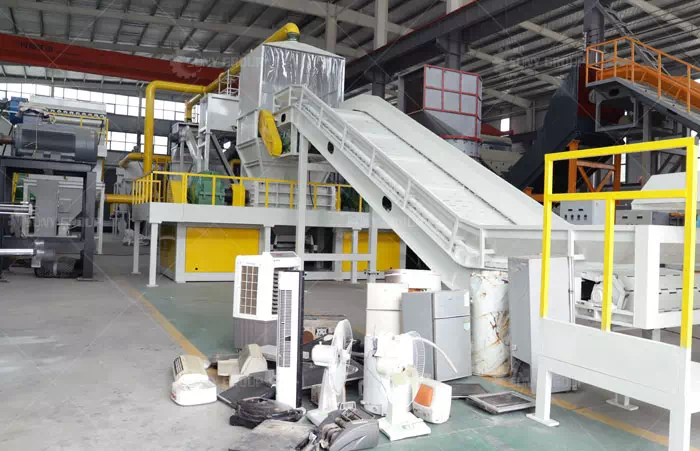
Small Mixed Household Appliance Waste Recycling Production Line
From Continuous Feeding to Two-Stage Crushing
Small appliances such as electric fans, rice cookers, electric kettles, and hair dryers typically consist of metal casings, motors, wiring, plastic, and other components. Since the dimensions and internal structures of different appliances vary, the recycling production line must be highly adaptable to different materials.
During processing, the material is first continuously fed from a hopper conveyor into a twin-shaft shredder. Through the mutual shearing and tearing action of the two cutting shafts, the entire unit and larger casings are broken down into smaller pieces, gradually exposing the internal metal components. The material then enters a manual sorting conveyor platform, where workers can pre-select exposed copper wires, copper tubes, and other high-value copper materials, thereby reducing copper loss caused by subsequent crushing.
The remaining material then enters a hammer mill for secondary crushing, further reducing particle size and allowing different materials to separate more thoroughly, thereby preparing the material for subsequent mechanical sorting.
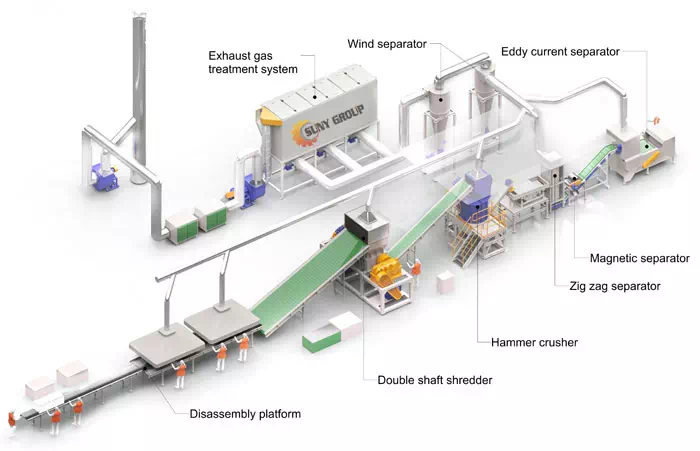
Structural Diagram of a Small Home Appliance Recycling Production Line
Magnetic Separation and Eddy Current Separation
The crushed mixed material first passes through a magnetic separator, which uses a magnetic field to separate ferromagnetic metals such as iron and steel. After magnetic separation, the non-ferrous metals and non-metallic components in the material are further concentrated.
Subsequently, the material enters a two-stage eddy current separation system. This equipment utilizes the differing responses of various metals to an alternating magnetic field to separate non-ferrous metals, such as aluminum, from other materials. The two-stage separation process facilitates further processing of the mixed material, reduces non-ferrous metal contamination, and improves separation efficiency.
Production Line Applications and Configuration
This type of mixed household appliance recycling production line can be used for small appliances such as waste fans, rice cookers, electric kettles, and hair dryers. Depending on the material characteristics and equipment configuration, it can also process other waste household appliances suitable for mechanical crushing and sorting.
The entire production line centers on a twin-shaft shredder, hammer mill, magnetic separator, and eddy current separator, supplemented by conveying and manual sorting stages, to achieve the sorting and recovery of metals from a variety of mixed household appliances. For equipment containing refrigerants—such as refrigerators and air conditioners—as well as appliances containing batteries, specialized pretreatment should be conducted in accordance with material characteristics and local regulations.
The actual equipment configuration should be determined based on the types of raw materials, their dimensions, metal content, and target output. Only by reasonably designing the shredding particle size and sorting sequence can both equipment operational stability and metal recovery efficiency be optimized.
Recommend products
CONTACT US:
If you have any requirement or suggestion, please fill in the form and send to us, thanks!E-mail:[email protected] | Whatsapp:+8613674945231