Twin Shaft Bulky Waste Shredder Machine
The twin-shaft bulky waste shredder is a heavy-duty volume-reduction machine utilising a low-speed, high-torque drive. It employs two counter-rotating cutter shafts to tear, shear and compress large, mixed and tough waste materials, making it suitable for pre-shredding prior to subsequent sorting, conveyance or further processing.
This design is particularly effective for waste with irregular dimensions and a high impurity content. For example, furniture timber, waste plastics, rubber, textiles, industrial packaging waste and mixed household waste are often not composed of a single hard material, but rather contain a mixture of both soft and hard materials. The twin-shaft cutters first grasp and tear the material, before further reducing its volume through the gaps between the blades, thereby minimising the likelihood of bridging and blockages.
Furthermore, the equipment operates at low rotational speeds, with the actual speed typically adjusted according to material characteristics, blade configuration and target output size. Low speed does not imply low processing capacity; its core advantage lies in utilising high output torque to process large chunks and highly resilient materials, whilst simultaneously reducing dust, noise and unnecessary blade wear caused by high-speed impact.
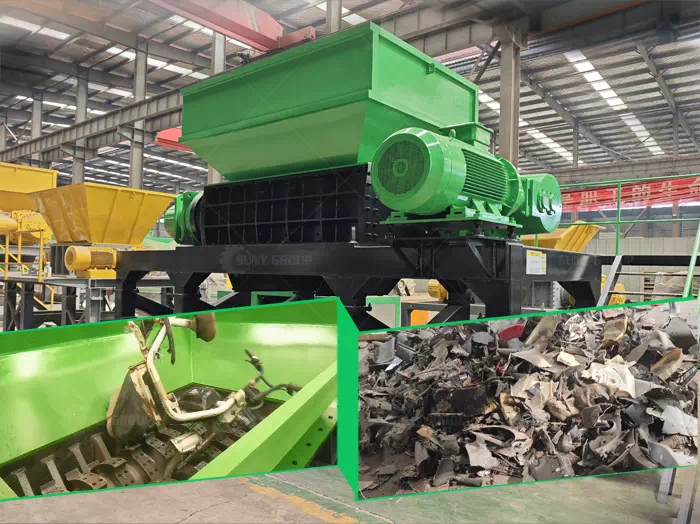
Twin Shaft Bulky Waste Shredder Machine
Key Components and Practical Applications
The core components of a twin-shaft bulky waste shredder primarily include the cutter shafts, shredding blades, gearbox, drive system, bearing housings, and automatic control system. Among these, the material and structure of the blades directly affect the service life of the equipment. For different types of waste, blades of varying thicknesses, tooth profiles, and blade spacing can be selected to balance throughput, output size, and wear resistance.
In actual production, twin-shaft shredders are typically used as primary pre-treatment equipment. In MSW (Municipal Solid Waste) treatment projects, bulky mixed waste can first be shredded to a size suitable for conveyance and sorting; on RDF/SRF production lines, they serve as volume-reduction equipment at the front end of fuel preparation; when processing waste plastics, rubber, wood and industrial waste, suitable blades and screening systems can also be configured according to the requirements of downstream equipment.
It should be noted that shredders should not simply aim for ‘the finer, the better’. For RDF, plastic recycling or subsequent magnetic and air separation processes, a reasonable pre-shredding size is more important than merely increasing fineness. Excessive shredding not only increases energy consumption but may also complicate subsequent sorting. Therefore, equipment selection should be determined in conjunction with material composition, feed size, target throughput, and final output requirements.
For waste with high moisture content, high entanglement, or complex composition, twin-shaft equipment is generally more suitable as front-end coarse crushing equipment than single-shaft high-speed shredding methods. However, the final choice of cutting tools, drive power, and processing capacity must still be determined based on actual material testing.
In summary, the value of a twin-shaft bulky waste shredder lies not merely in ‘reducing the size’ of waste, but in transforming waste with significant variations in size and shape into material more suitable for conveying, screening and secondary processing through a stable, low-speed, high-torque shredding process, thereby providing stable front-end processing conditions for a complete waste resource recovery production line.
Recommend products

CONTACT US:
If you have any requirement or suggestion, please fill in the form and send to us, thanks!E-mail:sunymachine@gmail.com | Whatsapp:+8613674945231