Used Beverage Can Recycling Line for Aluminum Recovery
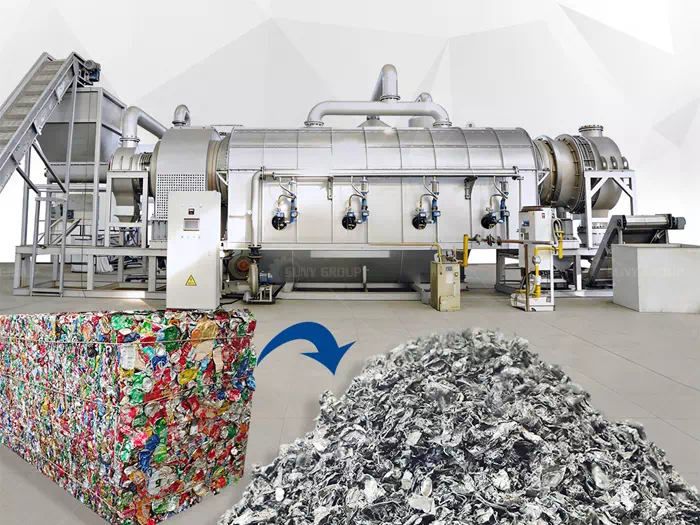
The scrap beverage can (UBC) recycling production line utilises equipment such as thermal paint stripping, crushing, and multi-stage sorting to process waste aluminium cans into aluminium feedstock suitable for subsequent smelting. The appropriate configuration of each processing stage helps to remove surface coatings, reduce impurities, and improve the efficiency of aluminium resource recovery.
Used Beverage Can Recycling Line for Aluminum Recovery
Scrap Aluminium Can Shredding and Pre-treatment Equipment
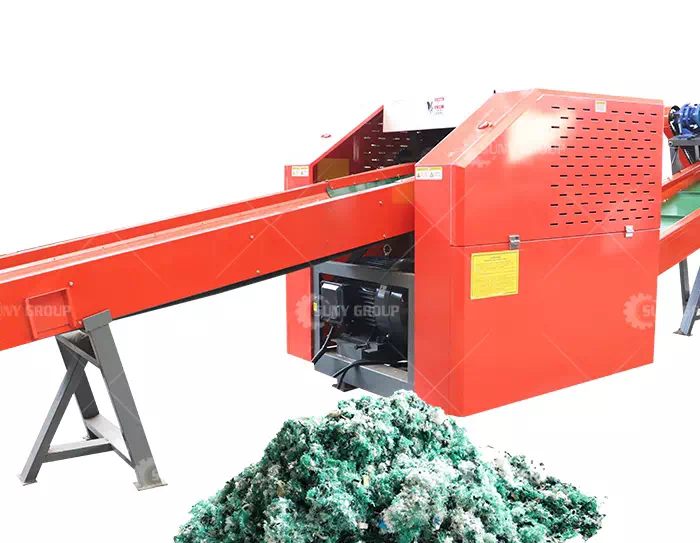
The production line begins by pre-treating the collected used beverage cans. Depending on whether the raw material consists of loose cans or those compressed into bales, shredders and crushers can be configured as appropriate to gradually process the material to a particle size suitable for subsequent thermal treatment and sorting.
Shredders are primarily used for initial crushing and reducing material size, whilst hammer mills can further break up the cans, making the material more receptive to subsequent thermal treatment. The particle size of the crushed material affects both the uniformity of heat distribution and the effectiveness of sorting; therefore, equipment selection must be determined in conjunction with the raw material’s form, processing capacity and target output size.
Thermal Paint Removal and Carbonisation Treatment System
The surfaces of waste beverage cans typically bear printing ink, external coatings and internal protective paint. If these enter the smelting process without adequate treatment, the organic matter may increase flue gas emissions, aluminium oxidation losses and slag formation.
The carbonisation paint-stripping furnace decomposes or removes the organic coatings from the can surfaces by controlling the heating temperature, processing time and furnace atmosphere. Appropriate heat treatment helps to reduce organic impurities in the aluminium feedstock, providing more suitable raw material for subsequent smelting.
During operation, particular attention must be paid to controlling the feed rate, furnace temperature and residence time. Insufficient temperature may result in incomplete paint removal, whilst excessively high temperatures may increase the risk of aluminium oxidation. Therefore, specific parameters should be adjusted according to the type of coating, material dimensions and equipment configuration.
Furthermore, the flue gas collection and purification system is a vital component of the production line, serving to collect and treat the exhaust gases generated during the heat treatment process. When selecting equipment, one should simultaneously evaluate paint-stripping capacity, energy consumption and exhaust gas treatment requirements, rather than focusing solely on the main unit’s production capacity.
Multi-stage Sorting and Aluminium Scrap Recovery
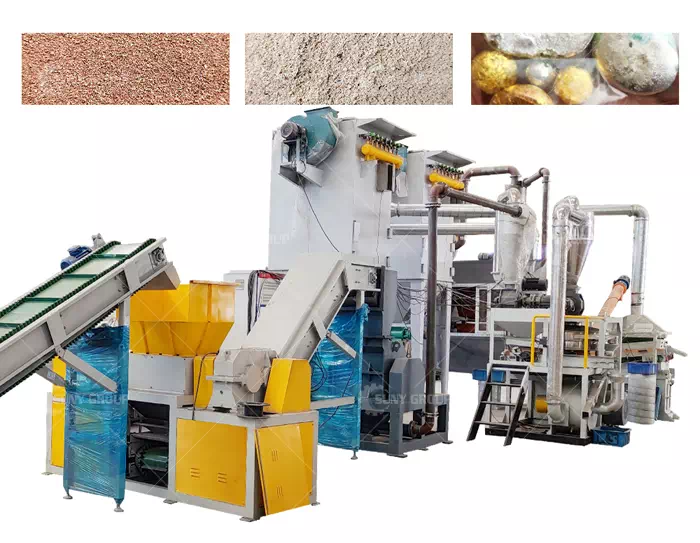
Following thermal paint stripping, the material enters the sorting stage, where screening, magnetic separation and other suitable sorting equipment are utilised to further remove impurities and enhance the quality of the aluminium scrap.
For example, magnetic separators can be used to remove residual ferromagnetic metals. If the raw material is contaminated with other non-ferrous metals or non-metallic impurities, equipment such as eddy current separators can be configured according to the material composition to improve the separation efficiency of different materials.
Once sorting is complete, the aluminium material can proceed to the subsequent smelting process to produce recycled aluminium feedstock. The actual recovery rate and purity of the finished product depend on the composition of the raw material, the size of the crushed particles, the effectiveness of paint stripping, and the suitability of the sorting equipment; they are not determined by a single piece of equipment alone.
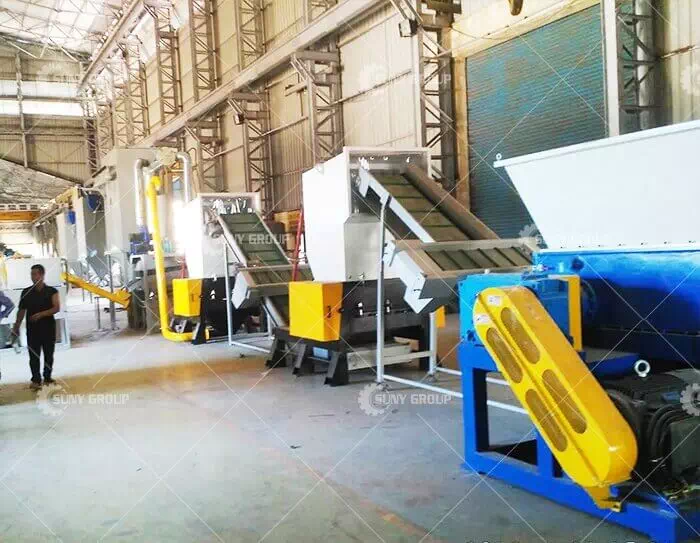
Therefore, when planning a production line for the recycling of used beverage cans, it is advisable to comprehensively consider the hourly processing capacity, aluminium recovery rate, paint stripping effectiveness, energy consumption, and environmental protection measures, and to determine a suitable combination of equipment to improve the operational stability and resource utilisation efficiency of the entire production line.
Recommend products
CONTACT US:
If you have any requirement or suggestion, please fill in the form and send to us, thanks!E-mail:[email protected] | Whatsapp:+8613674945231