WEEE Recycling Plant for Old Computers and Household Appliances
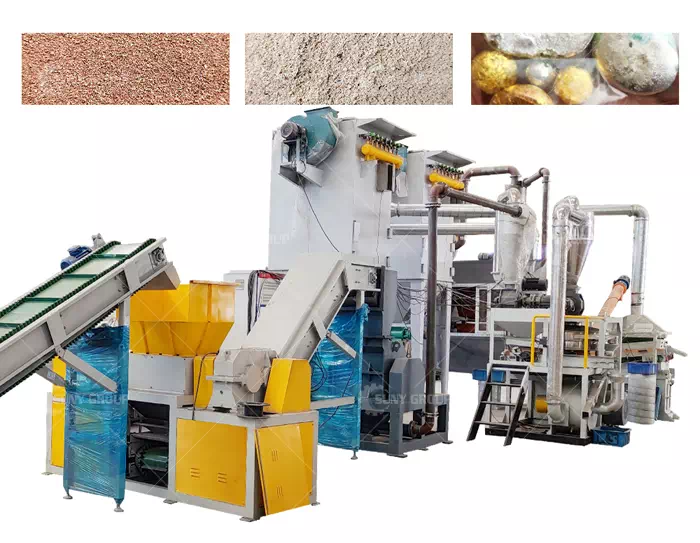
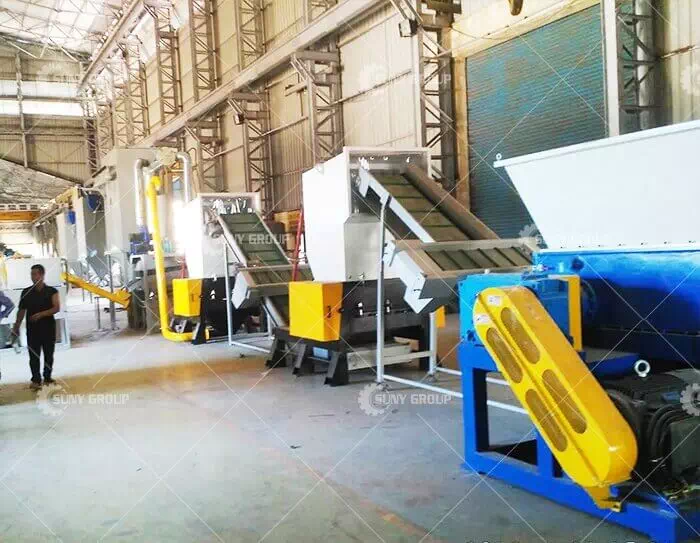
The WEEE (Waste Electrical and Electronic Equipment) recycling production line is an automated processing system that integrates crushing, grinding, and multi-stage sorting. It is used to recycle waste computers, monitors, rice cookers, refrigerators, and other end-of-life electrical appliances, sorting them into ferrous metals, non-ferrous metals, and other materials to facilitate subsequent resource recovery.
WEEE Recycling Production Line Processing Flow
Firstly, waste electrical and electronic equipment undergoes manual inspection and necessary pre-treatment to remove batteries, hazardous components, and parts unsuitable for direct shredding. Refrigeration equipment, such as refrigerators, must also have refrigerants and related components treated in accordance with applicable requirements; the entire unit cannot be fed directly into standard shredding equipment.
The pre-treated material enters a crusher or shredder, where larger appliance casings and internal components are shredded into pieces suitable for subsequent processing. Subsequently, crushing equipment further reduces the material size, facilitating the separation of metallic from non-metallic materials.
Once crushing is complete, the material proceeds to the sorting stage. Depending on the production line configuration, magnetic separation equipment may be used to separate ferrous metals such as iron and steel, whilst technologies such as eddy current separation are employed to recover certain non-ferrous metals, such as copper and aluminium. Plastics, rubber and other non-metallic materials are directed to the appropriate separation or further processing stages based on their material properties.
It should be noted that shredding does not equate to the completion of recycling. If the particle size of the material is uneven, or if different materials remain tightly bonded, this may affect the quality of metal recovery even when sorting equipment is in place. Therefore, at this stage, comprehensive consideration should be given to the types of raw materials, pre-treatment requirements, target particle size and sorting methods, rather than focusing solely on the processing capacity of a single piece of equipment.
How to select WEEE recycling equipment?
Different types of waste electrical and electronic equipment have varying requirements in terms of equipment configuration. For example, computers and monitors contain materials such as circuit boards, metals and plastics; small household appliances such as rice cookers comprise metal casings and various internal components; whilst refrigerators require particular attention to the pre-treatment of the refrigeration system and the handling of insulation materials.
Consequently, prior to procuring a WEEE recycling plant, it is advisable to clarify the daily processing capacity, feed size, material composition, target recoverables and site conditions, and to configure the equipment and conduct trial assessments based on the actual feedstock. Specific production capacity, output particle size, and metal recovery rates should be determined based on the characteristics of the raw materials, the equipment configuration, and test results.
If you are interested in this or have any requirements, SUNY GROUP can provide appropriate equipment configuration solutions tailored to the processing needs of waste computers, televisions, and domestic appliances. Please feel free to contact us at any time for further details!
Recommend products
CONTACT US:
If you have any requirement or suggestion, please fill in the form and send to us, thanks!E-mail:sunymachine@gmail.com | Whatsapp:+8613674945231