Lithium Battery Anode Recycling Line for Copper Foil and Black Mass
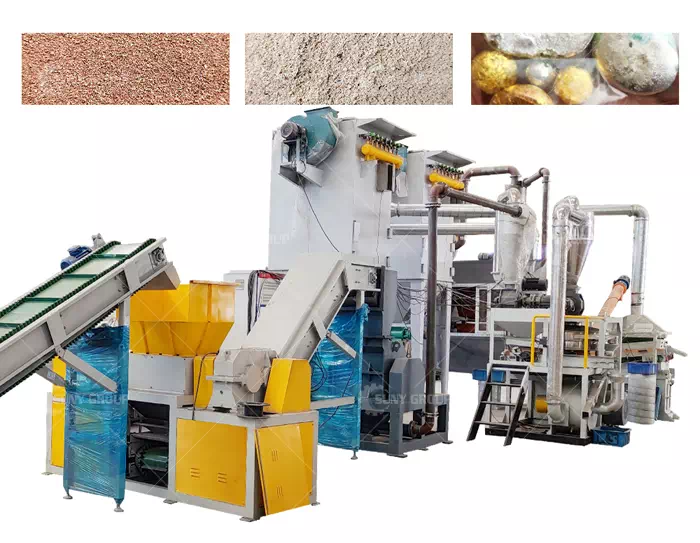
A lithium-ion battery anode recycling line primarily utilises equipment such as shredders, crushers, grinders, screens, and air classification systems to separate the graphite active material from the copper foil in the anode sheets, yielding black powder and copper foil that can be further utilised, whilst reducing the burden of manual disassembly and subsequent processing.
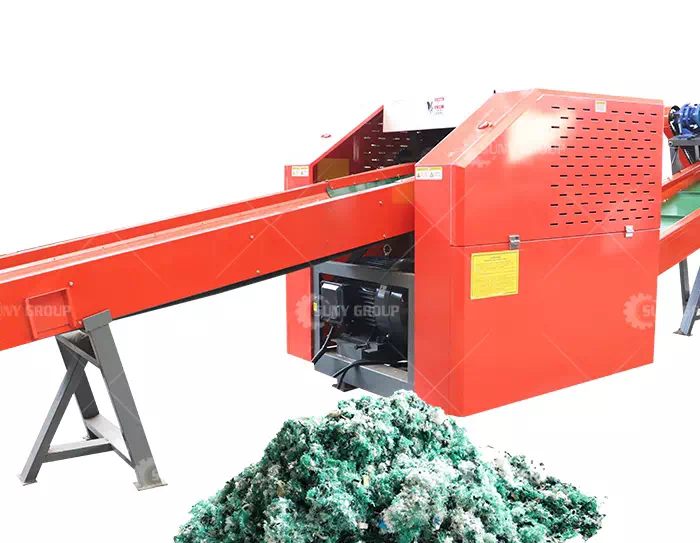
A complete anode recycling system typically begins with a twin-shaft shredder or pre-crusher. This equipment first breaks down waste anode sheets and production offcuts into smaller pieces, causing the graphite coating to gradually peel away from the surface of the copper foil. The material then proceeds to a fine crusher or grinder for further separation. The aim here is not simply to achieve a finer particle size, but to control the intensity of the crushing process to prevent the copper foil from being excessively pulverised and mixed with the graphite powder.
Multi-stage Screening and Sorting Equipment
After crushing and grinding, the mixture must pass through vibrating screens, cyclone separators, air classifiers or other precision separation equipment. Graphite particles are typically very fine, whilst copper foil has a larger, flake-like structure; by exploiting differences in particle size, shape and density, the two types of material can be progressively separated.
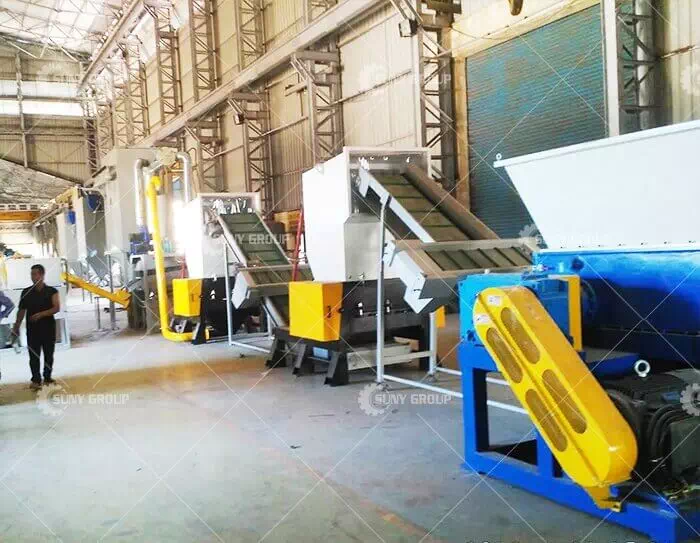
The equipment configuration typically includes:
Shredder: to carry out the initial volume reduction and crushing of the anode foils;
Crusher/Grinder: to enhance the separation of graphite from copper foil;
Vibrating screen: to classify the material according to particle size;
Air classification equipment: to further remove lightweight impurities and improve the separation efficiency of graphite powder;
Dust extraction system: Collects fine particulate dust to improve the production environment;
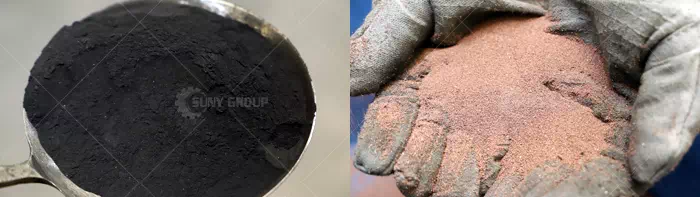
Black Powder and Copper
Shifting from ‘producing black powder’ to ‘improving separation quality’
The value of this Lithium Battery Anode Recycling Line lies not merely in converting waste anode sheets into powder, but in ensuring that copper foil and graphite are directed into separate material streams as far as possible through continuous mechanical control of the three stages: dissociation, classification and separation.
Furthermore, for copper foil, the focus is on minimising graphite adhesion; for black powder, the aim is to control the copper impurity content. Consequently, equipment selection should not be based solely on individual unit throughput, but should also take into account raw material type, processing capacity, target particle size, copper foil integrity and black powder purity.
For raw materials with relatively stable compositions, such as battery production waste and anode scrap, a dedicated continuous sorting line can be employed; for mixed waste batteries, however, additional pre-treatment and fine separation stages are required.
The ultimate objective is to convert waste lithium-ion battery anode materials into the two main products—copper foil and black powder—through the appropriate configuration of shredding, grinding, screening, air classification, and dust collection equipment, thereby providing a stable supply for subsequent copper resource recovery and graphite reuse.
Recommend products
CONTACT US:
If you have any requirement or suggestion, please fill in the form and send to us, thanks!E-mail:[email protected] | Whatsapp:+8613674945231