Aluminum Can Recycling Line with Eddy Current Separator
The aluminium can recycling production line utilises processes such as crushing, conveying, and eddy current separation to separate the aluminium metal from plastic, coating residues, and other non-metallic impurities in waste aluminium cans, thereby improving the efficiency of aluminium resource recovery and providing raw materials for subsequent smelting and reuse.
Workflow of the aluminium can recycling production line.
After undergoing initial crushing, waste aluminium cans are reduced to relatively small pieces; however, the crushed material may still contain plastic, labels, coating fragments, and a small amount of other impurities. If this material were to proceed directly to the smelting process, it would not only compromise the quality of the raw material but could also increase the burden on subsequent processing stages.
Consequently, the production line typically employs a combination of conveyor equipment and eddy current separators. The crushed aluminium can material is fed evenly into the sorting area by a conveyor, ensuring the material passes fully through the sorting equipment and minimising the impact of accumulation and overlapping on the separation efficiency.
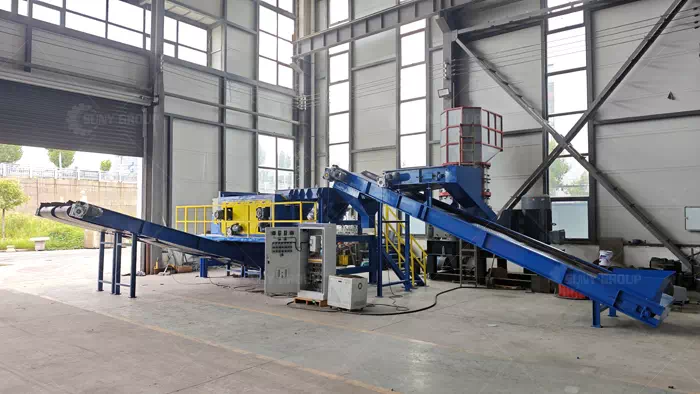
Aluminum Can Recycling Line with Eddy Current Separator
How an Eddy Current Separator Separates Aluminium from Plastic
The eddy current separator is a key piece of equipment in the aluminium can recycling production line, primarily used to separate non-ferrous metals such as aluminium and copper from non-metallic materials such as plastic and rubber.
The high-speed rotating magnetic rotor inside the equipment generates an alternating magnetic field. When the crushed aluminium can fragments pass through the sorting zone, induced eddy currents are generated within the non-ferrous metals, causing them to be subjected to electromagnetic repulsive forces and ejected in a specific direction; plastic and other non-conductive materials, on the other hand, fall primarily under the influence of gravity. By adjusting the material flow rate, conveyor speed, and sorting parameters, the separation efficiency between metals and non-metals can be improved.
In actual operation, the sorting efficiency depends not only on the rotational speed of the magnetic rotor but is also influenced by the size of the aluminium fragments, material thickness, moisture content, and the uniformity of the feed. Excessive feeding can easily cause material to overlap, increasing the risk of aluminium entering the impurity stream.
Key Considerations for Application and Selection
Eddy current separators are widely used in the recycling of scrap aluminium cans, the processing of electronic waste and the sorting of mixed waste. Following effective separation, the recovered aluminium can proceed to fine sorting or smelting processes, whilst the separated plastics can undergo further processing based on their composition and degree of cleanliness.
When selecting equipment, particular attention should be paid to verifying the processing capacity (kg/h or t/h), feed particle size range, aluminium recovery rate and the purity of the material after sorting. It should be noted that recovery rate and purity are not the same indicators; actual values should be determined through testing with representative materials.
SUNY GROUP can configure appropriate crushing, conveying, and eddy current separation equipment based on the material composition of the scrap aluminium cans, the target production capacity, and site conditions. Please feel free to enquire about equipment prices, technical specifications, and comprehensive aluminium can recycling solutions.
Recommend products
CONTACT US:
If you have any requirement or suggestion, please fill in the form and send to us, thanks!E-mail:sunymachine@gmail.com | Whatsapp:+8613674945231