Glass Cullet Sorting Line for Laminated Glass Recycling
The laminated glass recycling and separation production line developed by SUNY GROUP is a set of mechanical processing equipment designed for waste materials such as automotive windscreens and laminated glass. Through pre-treatment, glass crushing, PVB film separation, and screening, it converts composite glass—which is otherwise difficult to utilise directly—into two recyclable materials: glass cullet and plastic film.
Laminated glass is typically composed of two or more layers of glass bonded to an intermediate PVB (polyvinyl butyral) film through a process of heating and pressurisation. Whilst this structure provides safety and shatter-resistance, it also complicates the recycling process. Conventional glass crushers can only break the glass into fragments; they are unable to effectively remove the PVB film adhering to the glass shards, which can easily lead to problems such as high levels of glass impurities and plastic film contamination in the glass feedstock.
Consequently, the recycling of laminated glass must not focus solely on crushing capacity; it must also control glass particle size, film integrity, and the effectiveness of subsequent separation.
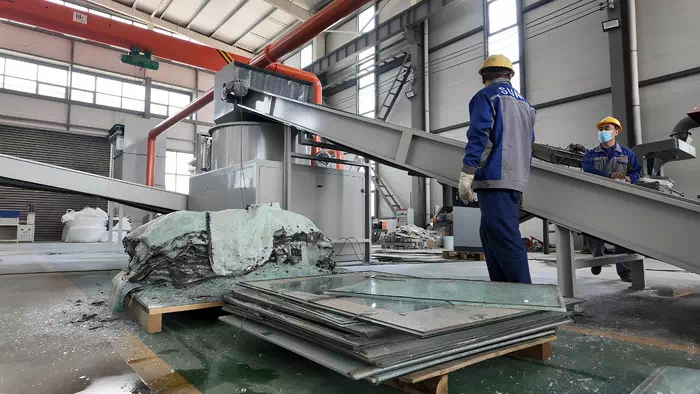
Glass Cullet Sorting Line for Laminated Glass Recycling
Workflow of the Glass and PVB Film Separation Production Line
The entire production line primarily consists of a feed conveyor, pre-compression crushing equipment, a glass and PVB separator, a screening unit, a material conveyor, and a dust collection system. Depending on the condition of the raw material and processing requirements, soaking pre-treatment equipment may also be configured.
1. Feeding and Pre-treatment
Scrap laminated glass undergoes manual inspection to remove obvious metal fittings, sealing materials, and other foreign matter unsuitable for entry into the equipment. For larger automotive windscreens, continuous feeding via conveyor equipment can be utilised to reduce manual handling.
Some production lines employ a soaking treatment to alter the bonding state between the glass and the PVB film. The specific soaking time must be determined based on glass thickness, film type, and process parameters; standardised parameters cannot be applied across the board.
2. Glass Crushing and Mechanical Separation
Pre-compression crushing equipment uses roller compression or specialised crushing mechanisms to break the laminated glass into fragments suitable for subsequent processing. Unlike the crushing of ordinary glass, the equipment must avoid excessive crushing, minimise the generation of glass powder, and ensure the PVB film remains separable.
The material then enters the glass-PVB separator. This equipment utilises mechanical force to gradually detach the glass fragments from the interlayer film, reducing the adhesion between the glass and the plastic. The effectiveness of separation depends not only on the equipment’s design but also on the moisture content of the raw materials, the dimensions of the glass and the degree of PVB ageing.
3. Screening and Material Collection
The separated material enters the screening system, where the glass fragments and PVB film are conveyed separately to their respective collection areas. Glass fragments may be further screened according to particle size requirements, whilst the PVB film must be inspected for residual glass.
A complete production line may also be equipped with enclosed conveying and dust collection systems to minimise the dispersion of fine glass particles during transfer. The resulting glass fragments can proceed to the recycled glass processing stage, whilst the recovered PVB film undergoes further treatment based on its cleanliness and market requirements.
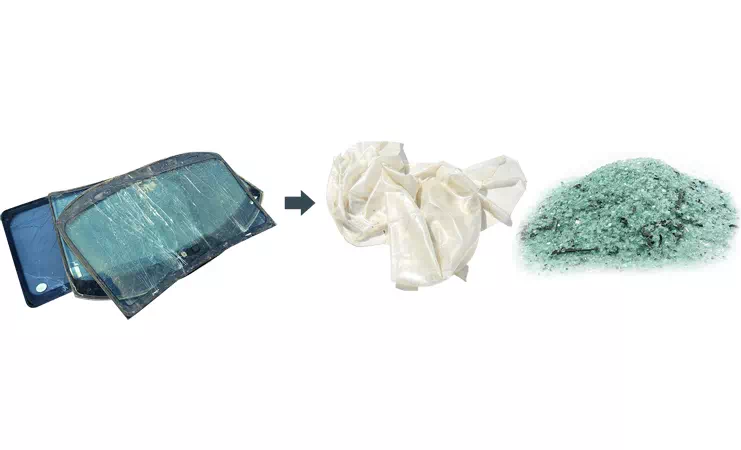
The Recycled PVB Film and Glass from Laminated Glass
Equipment Selection and Production Line Configuration
When selecting laminated glass recycling equipment, three key aspects should be prioritised: raw material dimensions, processing capacity and separation quality.
Automotive windscreens typically have a certain curvature, whilst architectural laminated glass may vary in thickness and dimensions; therefore, the feed width, crushing mechanism and conveying method must be tailored to the actual raw materials. For continuous production projects, particular attention should be paid to verifying the equipment’s hourly throughput, actual operating speed and the suitability of the screening system.
Production line configuration should not simply aim for greater crushing capacity. Finer glass particles do not necessarily indicate better separation results. Excessive crushing may increase the proportion of fine powder, causing glass debris to become entrapped in the PVB film, whilst simultaneously increasing the burden on the screening and dust control systems.
Consequently, a reasonable laminated glass recycling solution should determine the equipment configuration based on raw material type, target glass particle size, PVB film recovery requirements, and plant conditions, and verify the separation effectiveness through practical material testing. Should you be interested or require further assistance, please feel free to contact us at any time for a consultation.
Recommend products
CONTACT US:
If you have any requirement or suggestion, please fill in the form and send to us, thanks!E-mail:sunymachine@gmail.com | Whatsapp:+8613674945231