Jelly Filled Telecom Cable Recycling Equipment
Recycling equipment for gel-filled telecommunications cables is designed to remove the viscous, water-resistant gel from end-of-life telecommunications cables whilst separating out the copper and plastic, thereby transforming difficult-to-process cable waste into reusable metal and plastic resources.
Pre-treatment System Designed for Gel-Filled Cables
Unlike standard dry wires, gel-filled telecommunications cables typically contain an oily or gel-like filling to protect against moisture. As this material is viscous, processing it directly using a standard dry copper granulator can easily lead to material adhesion and reduced sorting efficiency; therefore, the equipment must first address the issue of ‘gel removal’.
The entire production line typically begins with a conveyor, which feeds the waste telecommunications cables into a twin-shaft shredder for primary shredding. This reduces large-sized cables into small pieces of approximately 20–30 millimetres, whilst a magnetic separator removes ferrous impurities, thereby creating stable feed conditions for subsequent sorting.
Washing, Gel Removal and Copper-Plastic Separation Are Key
The pre-shredded cables enter flotation or washing equipment, where water and appropriate washing processes reduce the adhesion of the gel to the material’s surface, whilst further separating any plastic sheathing that has already detached from the metal. For cables with significant oil or gel content, this step is not merely a simple ‘washing’ process, but a critical stage for the stable operation of the entire system.
The washed material is conveyed via a screw conveyor to a knife mill for secondary fine crushing, reducing the particle size further to approximately 2 millimetres and ensuring thorough separation of copper from plastic. Subsequently, a shaking table is used to perform fine sorting based on the density difference between copper and plastic, whilst a dewatering machine and hot-air drying equipment are employed to process the copper particles. Certain equipment configurations can achieve a copper particle purity of 99 per cent or higher; specific results remain dependent on the composition of the raw material, the rubber content and the equipment parameters.
Equipment Configuration and Actual Processing Capacity
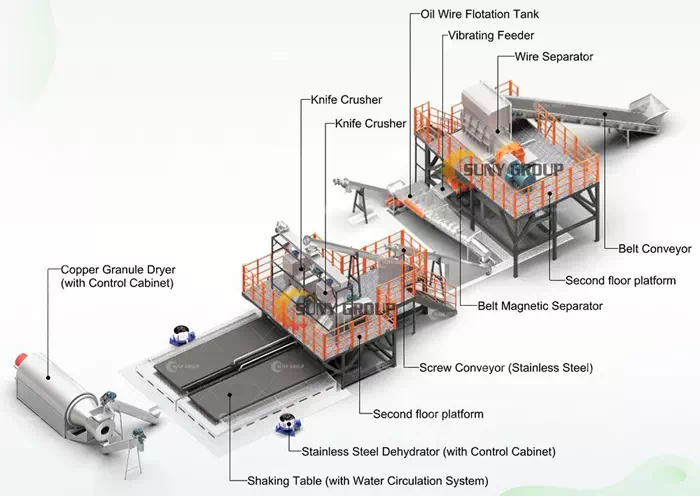
Jelly Cable Recycling Line Structure
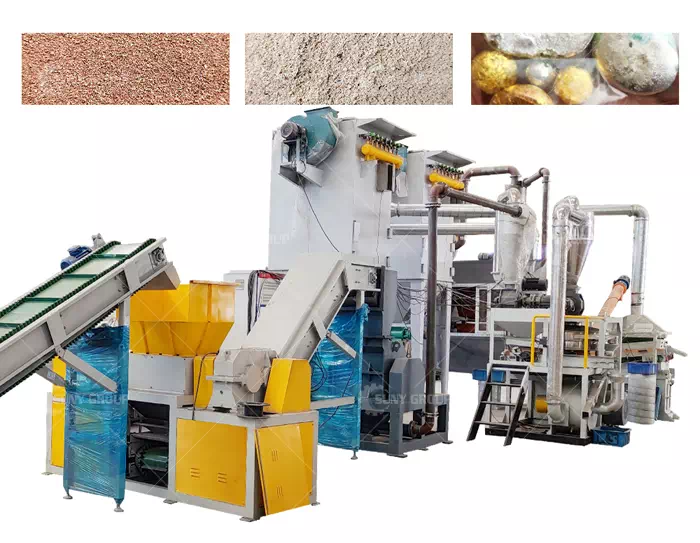
A complete cable recycling production line typically comprises conveyors, a twin-shaft shredder, a magnetic separator, flotation/washing equipment, screw conveyors, a blade-type pulveriser, a shaking table and a PLC control system. The centralised PLC control coordinates the operating parameters of the various pieces of equipment, reducing the need for manual intervention.
Taking a publicly available 8–10 t/h equipment configuration as an example, it is suitable for cables with diameters of approximately 5–20 mm; the total power consumption of the entire production line is approximately 557 kW, and the equipment dimensions are approximately 30 × 15 × 7.5 m. Another type of 4–5 t/h configuration employs a combined process of crushing, washing, fine crushing, gravity separation, and water recirculation.
The value of such equipment lies not merely in ‘shredding cables’, but rather in the design of a comprehensive process flow that addresses the practical challenges of gel treatment and the separation of copper from plastic. The end result is relatively clean copper and plastic pellets, suitable for the resource recovery of waste telephone lines, telecommunications cables, underground communication cables and other oil- and gel-containing cables.
Recommend products
CONTACT US:
If you have any requirement or suggestion, please fill in the form and send to us, thanks!E-mail:[email protected] | Whatsapp:+8613674945231