Small-Scale Lithium Battery Recycling Lines | China Manufacturer
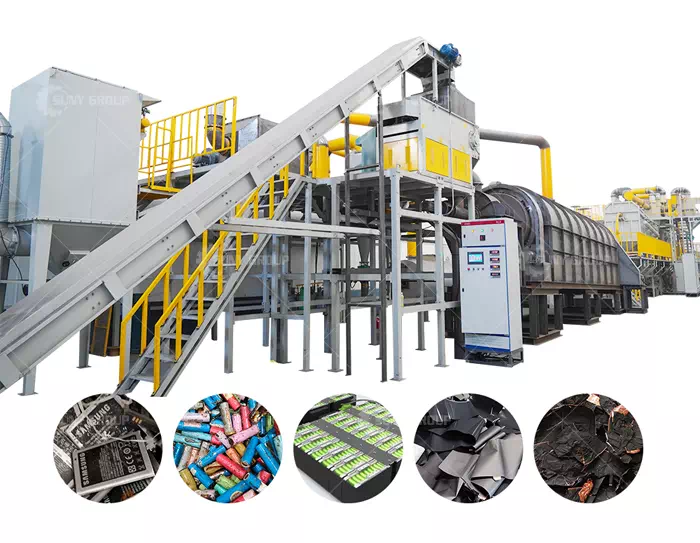
The small-scale 100 kg/h lithium battery recycling lines developed by SUNY GROUP in China is a compact mechanical sorting system designed for waste pouch cells, 18650 cylindrical cells, and mobile phone batteries. Its core function is to achieve the effective recovery of black powder, copper foil, aluminium foil and casing materials through crushing, screening and physical separation technologies, thereby effectively controlling investment costs and enhancing the value of resource utilisation.
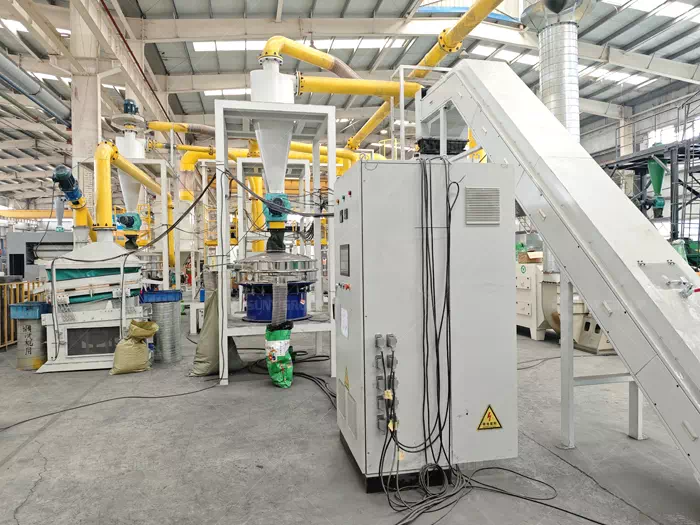
Small-Scale Lithium Battery Recycling Lines
Process Composition and Operating Principles
For small-scale projects with a processing capacity of around 100 kg/h, the equipment configuration places greater emphasis on stability and adaptability rather than simply pursuing production capacity. The entire production line typically adopts a modular design, comprising a single-shaft shredder, a vibrating screen, a hammer mill, a magnetic separator, air classification equipment, and an air classification system.
The production process begins with pre-treatment by a single-shaft shredder. Compared to twin-shaft shredding equipment, the single-shaft design allows for better control of output particle size, reduces the problem of excessive entanglement of aluminium and copper foil, and simultaneously alleviates the burden on subsequent screening stages. Following initial shredding, the material size is typically controlled between 20 and 50 mm, making it more suitable for subsequent sorting processes.
The material then enters a circular vibrating screen for preliminary classification based on particle size. Larger metal casings and plastic components are sent for further processing, whilst finer particles proceed to the fine separation system to enhance overall recovery efficiency.
Multi-stage Sorting and Recovery Performance
The core competitiveness of lithium-ion battery recycling equipment lies not in its crushing capacity, but in its sorting precision.
After screening, the material sequentially passes through a Z-type air classifier, magnetic separation equipment, and a hammer mill system. The magnetic separation equipment is primarily responsible for extracting steel casings and ferrous impurities, thereby reducing metal contamination in the black powder; the hammer mill further releases the active materials adhering to the surfaces of copper and aluminium foils, improving the recovery rate of black powder.
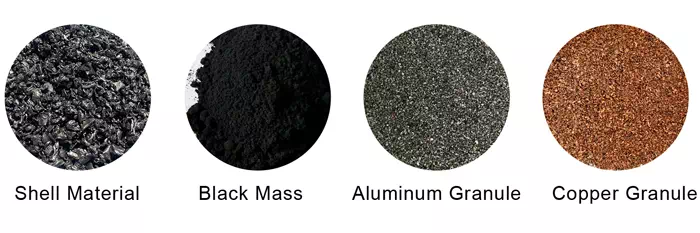
Materials Recovered from Lithium Batteries
During the fine material processing stage, the air classification system utilises the density differences between materials to achieve separation. The black powder, composed of graphite and lithium compounds, is collected into a dedicated system, whilst the copper foil and aluminium foil are directed to their respective recovery units.
In practical projects, the particle size of black powder typically falls within the range of 0.1–1 mm, whereas the copper and aluminium metal particles are significantly larger; these physical characteristics facilitate mechanical sorting. For lithium iron phosphate (LFP) and ternary lithium batteries, due to differences in material composition, screen mesh specifications, airflow parameters, and crushing intensity often require targeted adjustments.
More Suitable for Small and Medium-Scale Projects
Compared to large-scale lithium-ion battery recycling plants processing 500 kg or even over 1 metric tonne per hour, a 100 kg/h processing line is better suited to pilot projects, small-scale recycling enterprises and regional resource recovery centres.
Such equipment typically occupies a floor area of between 100 and 150 square metres, has low power requirements, and can be installed under relatively flexible on-site conditions, whilst allowing for rapid adjustment of process parameters in response to changes in feedstock. For example, when processing pouch cells, greater emphasis is placed on film separation capability; when processing 18650 cylindrical cells, it is necessary to enhance the efficiency of metal casing crushing and magnetic separation.
Furthermore, small-scale production lines are easier to expand at a later stage. As the supply of raw materials increases, processing capacity can be gradually enhanced by adding crushing modules or fine sorting equipment, without the need to completely replace the existing system.
Recommend products
CONTACT US:
If you have any requirement or suggestion, please fill in the form and send to us, thanks!E-mail:[email protected] | Whatsapp:+8613674945231