Tire Shredder Machine with Rotary Screen for Efficient Tire Recycling
A scrap tyre shredder is a core piece of equipment used for the initial crushing of whole or chunked tyres. It processes high-strength rubber materials into fragments of a controlled size, providing a stable feedstock for subsequent crushing, sorting, or pelletising processes. It is a critical stage in the tyre recycling production line that determines both efficiency and the quality of the final product.
1. Structure and Working Principle of Tyre Shredders
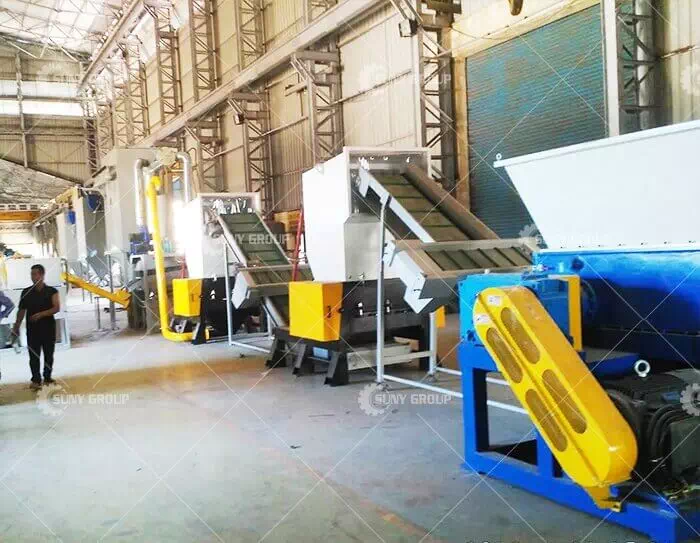
Tyres are inherently highly resilient, highly elastic, and structurally complex. If one relies solely on standard shredding equipment, problems such as inconsistent output sizes and an excessive amount of long, strip-like material are likely to arise. To address these characteristics, tyre shredders typically employ a twin-shaft or multi-shaft configuration. Through a low-speed, high-torque design, they achieve powerful shearing and tearing of the tyres.
During operation, the cutting shafts repeatedly tear at the tyres, gradually breaking them down into smaller pieces. However, a single shredding pass often fails to achieve the desired particle size, which is one of the fundamental reasons for the low efficiency of many recycling projects.
2. The Core Function of the Rotary Screening System
To avoid the issues of long, strip-like material and inconsistent particle sizes, advanced tyre shredders are typically equipped with a rotary screening system. The key to this configuration lies in the closed-loop control of ‘screening plus recirculation’.
Once the shredded material enters the rotary screen, small particles pass directly through the screen openings, whilst larger pieces that do not meet the size requirements are automatically returned to the shredding chamber for secondary processing. Through this recirculation mechanism, the equipment can continuously adjust the output particle size, achieving a more uniform output.
Compared to traditional single-pass shredding methods, this design not only effectively reduces the production of long rubber strips but also significantly improves the processing efficiency of downstream equipment (such as crushers, sorters, and pelletisers), whilst reducing overall energy consumption and the risk of blockages.
3. The Impact of Equipment Configuration on Overall Line Efficiency
In tyre recycling projects, the shredding stage does not operate in isolation but serves as the starting point of the entire production line. If the feed from the front end is unstable, it will directly slow down all subsequent processes.
A well-designed equipment configuration, particularly a shredder equipped with a rotary screening system, can control material size at source, ensuring smoother operation of the entire production line. A stable and uniform output not only enhances processing efficiency but also improves the purity of the final rubber granules or steel cord separation.
Therefore, when selecting equipment, focusing solely on price often overlooks critical performance differences. What truly impacts long-term profitability is the equipment’s structural design, its ability to control output, and how well it integrates with the entire production line.
Recommend products

CONTACT US:
If you have any requirement or suggestion, please fill in the form and send to us, thanks!E-mail:sunymachine@gmail.com | Whatsapp:+8613674945231