Wires Copper Extraction Machine
A copper wire extraction machine (copper granulator) is a piece of equipment designed to efficiently separate the copper core from the external plastic or rubber insulation in scrap electrical wires. Its primary function is to convert low-value mixed scrap wire into high-purity copper granules, thereby significantly increasing its recycling value and facilitating resource reuse.
I. Core Equipment Structure and Operating Principle
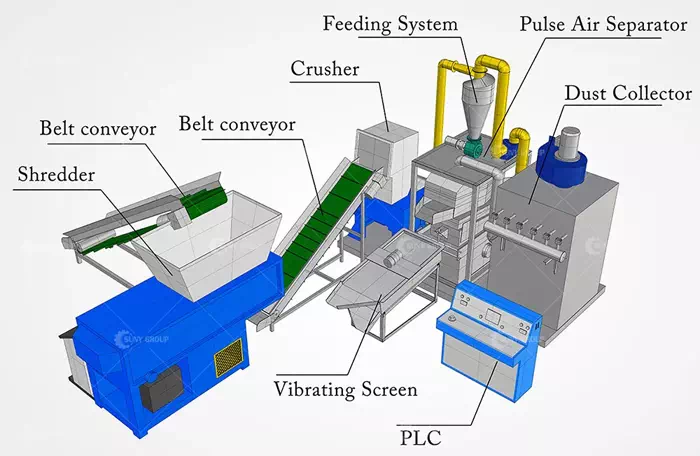
A copper granulator is essentially a combined ‘crushing and sorting’ system. The material first enters the crushing unit via the feeding system, where it is processed into fine particles after multi-stage crushing. It then enters the sorting system, where the copper particles are thoroughly separated from the plastic using airflow, vibrating screens, and the principle of density differences.
Unlike traditional wire stripping machines, the copper granulator does not rely on manual labour or a single cutting mechanism, but instead processes mixed cables through a continuous process, making it suitable for tangled, twisted, or even impure scrap wire. This design ensures greater stability and efficiency when processing complex materials.
II. Equipment Models and Processing Capacity Configurations
In terms of specifications, the main differences between various models of copper granulator lie in power output, processing capacity, and equipment dimensions:
The CR-200 is suitable for small-scale recycling operations, with a power output of 20 kW and a processing capacity of approximately 100–200 kg/h. It has a small footprint and is ideal for initial investment.
The CR-300 and CR-500 are medium-capacity machines, with power ratings of 55 kW and 105 kW respectively, and processing capacities of 200–500 kg/h; they are suitable for recycling enterprises with a stable feed supply.
The CR-1000 is an industrial-grade machine, with a power rating of 195 kW and a processing capacity of approximately 800–1000 kg/h; it is better suited to large-scale, continuous production requirements.
When selecting a model, do not focus solely on throughput; greater attention should be paid to equipment stability and energy efficiency. Many users overlook the fact that higher output demands greater precision in both upstream feeding and downstream sorting. If the system is not properly configured, this can actually lead to reduced efficiency and copper loss.
III. Application Value and Key Selection Criteria
The core value of a copper granulator lies not in ‘whether it can separate’, but in ‘how cleanly it separates and whether costs are controllable’. High-quality equipment can typically raise copper purity to over 99%, which directly determines the final selling price. Compared to selling scrap wire directly, processed copper granules generally command a higher premium.
When selecting equipment, three key factors must be prioritised:
Firstly, the range of wire types it can handle, including wire diameter, single-core or multi-core structure, and whether the material contains oil or impurities.
Secondly, production scale; if the supply of raw materials is unstable, blindly opting for large-scale equipment will only increase operational pressure.
Finally, the precision of the sorting system is the core factor affecting recovery rates and the area where technological differences between equipment are most pronounced.
Many procurement decisions fail not because the equipment is substandard, but because the specific characteristics of the raw material were overlooked during the selection phase, resulting in equipment that is ‘theoretically suitable but practically mismatched’. Overall, copper wire processing machines have evolved from single-purpose separation equipment into a standardised recycling solution, suitable for the majority of waste wire processing scenarios.
Recommend products
CONTACT US:
If you have any requirement or suggestion, please fill in the form and send to us, thanks!E-mail:sunymachine@gmail.com | Whatsapp:+8613674945231