Car Windshield Recycling Machine for Glass and PVB Separation
Automotive windscreen recycling machines are primarily used to process laminated glass from end-of-life vehicles. Through processes such as pre-crushing and separation, the glass is separated from the PVB interlayer, allowing the two materials to enter subsequent recycling stages separately, thereby improving the resource utilisation rate of waste windscreens.
Why Automotive Windscreens Require Specialised Recycling Equipment
Automotive windscreens typically feature a laminated structure, comprising two layers of glass with a PVB (polyvinyl butyral) interlayer in between. Compared to ordinary glass, the greatest challenge in recycling this material lies not in ‘crushing’, but in the tendency for glass fragments to adhere to the flexible PVB interlayer.
If processed directly using standard crushers, this can easily lead to problems such as the production of fine glass powder, entanglement of the PVB, and incomplete separation of the mixed materials. Consequently, specialised automotive windscreen recycling equipment is usually designed as an integrated system combining crushing and separation; by controlling the size of the crushed fragments and subsequent sorting parameters, the degree of contamination between the glass and PVB is minimised.
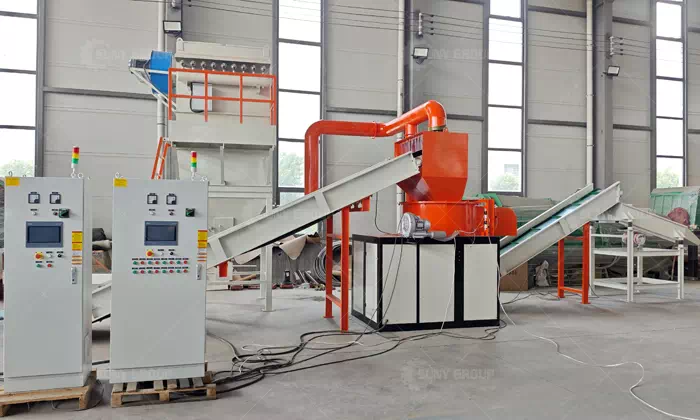
Car Windshield Recycling Machine for Glass and PVB Separation
Main Workflow of Windscreen Recycling Machinery
The entire process typically begins with manual or conveyor-fed loading, followed by pre-crushing of the waste windscreens to break the intact glass into fragments suitable for further processing. This is then followed by fine crushing and separation stages, during which the glass particles are gradually separated from the PVB film.
Screening, air-classification, or other separation units within the equipment sort the material based on differences in particle size, density, and morphology between the glass particles and the PVB. Following multi-stage processing, the glass is transformed into relatively clean glass cullet, whilst the PVB is collected in the form of film or fragmented film.
The specific configuration must be determined based on the dimensions of the windscreens, the processing capacity and the requirements for the end products. For example, if the manufacturer places greater emphasis on the cleanliness of the glass, the separation process between the glass and the PVB must be enhanced; if the aim is to increase the recycling value of the PVB, excessive pulverisation of the PVB during the crushing process should be minimised.
Utilisation of Separated Materials
The separated glass can serve as raw material for the glass industry, building materials and other recycled glass products, thereby reducing reliance on natural mineral resources. PVB, meanwhile, possesses a certain degree of reusability and can be further utilised in plastic modification, adhesives and other industrial materials.
Furthermore, windscreen recycling projects should not focus solely on ‘how many tonnes are processed per hour’; they should also prioritise glass purity, PVB recovery rates, crushing particle size, dust control and the stability of continuous operation. For actual recycling enterprises, the stable production of two separate, marketable materials is often more important than simply increasing the feed rate.
If you have any requirements or would like further information, please do not hesitate to contact us.
Recommend products
CONTACT US:
If you have any requirement or suggestion, please fill in the form and send to us, thanks!E-mail:sunymachine@gmail.com | Whatsapp:+8613674945231